


























Moving steel plate with chains and slings works—until the clock, the finish, and the crew size say otherwise. Every choke, shackle, and tag line adds setup time. Softeners protect edges but still leave marks. Thin sheet can kink under a single pick point. Long plate wants more than one lift point, which means more people under the load while the crane waits.
A below-the-hook lifting magnet grips ferrous plate from the face, so operators can pick, travel, and set without threading gear through the load. Used on the right steel, surface, and duty cycle, magnets cut cycle time and reduce handling damage. Used on the wrong load—non-ferrous alloys, heavy scale, warped plate, or intermittent electromagnets pushed past their cool-down—they become a drop risk dressed up as productivity. This guide is about knowing the difference.
When Magnets Beat Chains and Slings
Magnets win when the bottleneck is rigging time and surface contact, not raw lift capacity. Typical shop and yard cases:
- Repetitive plate moves—burn-table loading, stack de-staging, truck or railcar unloading, and staging flats for press or plasma where every sling wrap costs torch-on time.
- Finish-sensitive plate—coated, polished, or just-cleaned surfaces that chains and wire rope will dig, bruise, or stain.
- Thin-to-medium plate that needs distributed support so a single choke does not dish or crease the sheet.
- Crew reduction—one operator with a pendant or radio can attach, lift, and release without a second person crawling under or around the plate to set softeners.
If your day is mostly one-off odd shapes, open web fabrications, or mixed alloys, keep the sling rack warm. Magnets earn their keep on ferrous flats and blocks you move often enough that attachment time dominates the cycle.
Magnet Capacity Is Not the Nameplate Alone
Catalog capacity assumes ideal contact: thick enough ferrous section, clean flat poles, minimal air gap, and the load centered under the magnet array. Real plate rarely matches the brochure. Derate for:
- Thickness and magnetic circuit—thin plate saturates differently than heavy plate. Depth of field and single-sheet selectivity matter when you only want the top plate off a stack.
- Air gap—paint, rust scale, paper interleaf, warped crowns, and debris between poles and steel cut holding force fast. A small gap can erase a large share of rated capacity.
- Surface condition—hot-rolled mill scale, flame-cut slag, and oily film reduce effective contact area. Wipe and inspect poles; do not lift on hope.
- Load geometry—long plate needs multiple magnets on a beam so ends do not peel. Narrow strip, rounds, and angle need pole shoes or a different magnet style than a flat plate lifter.
- Temperature and alloy—hot plate and some stainless grades hold poorly or not at all. Magnets are a ferrous tool; aluminum, copper, and many stainless families need vacuum or mechanical grabs instead.
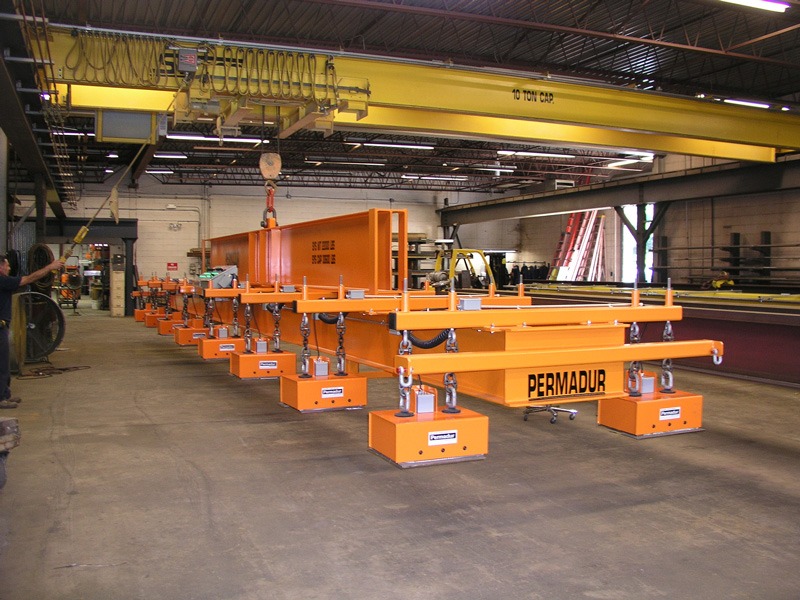
Read the capacity chart that ships with the magnet—especially thickness and surface derates—before you treat the stamped tonnage as gospel. Builders of electro-permanent plate systems such as Permadur typically publish those derating tables on the unit for a reason: the shop floor decision is contact quality, not marketing capacity.
Duty Cycle: Permanent, Electro, and Electro-Permanent
Not every “magnet” behaves the same when power blinks or the shift runs long:
- Manual permanent magnets—lever or cam actuates the magnetic circuit. No power needed to hold. Simple and rugged for many plate and block lifts, with capacity and ergonomics that still depend on full pole contact.
- Electromagnets—holding force exists only while current flows. They can be powerful and fast, but continuous duty may require cool-down, and a power loss drops the load unless you add backup batteries or mechanical retainers. Match published duty cycle to your lift frequency.
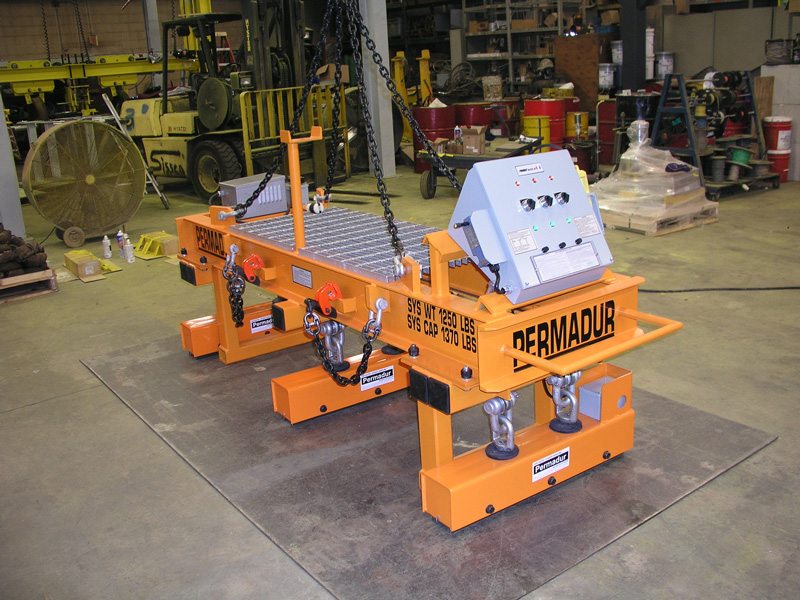
- Electro-permanent (electrically controlled permanent) magnets—a short pulse turns the magnet ON or OFF; permanent magnetism holds the load afterward. Power is not required to maintain the lift, which is why these designs are common where fail-safe hold during a power interruption matters.
Duty cycle questions to ask before purchase: How many picks per hour? How long is each lift suspended? Do you need selective magnet banks for partial plate or skeleton picks? Is control AC shop power, onboard battery, pendant, or radio? Spec the magnet family to the production tempo—not the other way around.
Multi-Magnet Spreads for Long Plate
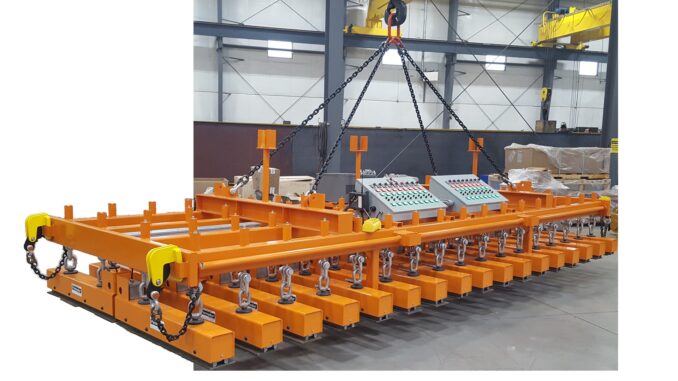
A single magnet in the center of a 40-foot plate is an invitation for end droop, peel, and a surprise release. Long and wide plate usually rides under a magnet beam or array: multiple magnets spaced so each section of the plate stays within its share of capacity and stiffness. Selective controls let operators energize only the magnets over the plate or over cut parts, which is how burn-table shops pull skeletons and nests without re-rigging every time.
Layout rules of thumb:
- Space magnets so unsupported spans stay within plate stiffness and magnet peel limits for your thickness.
- Keep the array square to the plate; cocked beams create uneven air gaps and uneven load share.
- Confirm crane capacity for magnet system weight plus plate—below-the-hook gear is not free payload.
- Use the manufacturer’s single-plate and multi-part guidance when you intend to lift cut parts or skeletons in one pick.
When Mechanical Rigging Still Wins
Reach for chains, wire rope, synthetics, clamps, or vacuum when magnets are the wrong physics or the wrong risk profile:
- Non-ferrous or weakly magnetic materials—aluminum, copper, brass, many stainless grades, composites, and wood.
- Open shapes and fabrications—trusses, frames with large cutouts, pipe racks, and assemblies where poles cannot sit on continuous ferrous face.
- Dirty, heavily scaled, or badly warped plate that will not seat—fix the surface or change tools before you “try a little lift.”
- Loads that must be turned, flipped, or edge-rolled in ways your magnet beam is not designed to control.
- Critical lifts over people or expensive workcells where your written lift plan still calls for redundant mechanical retention—follow the plan, not the shortcut.
Magnets are a production tool for the right ferrous flats. They are not a universal replacement for competent rigging.
Inspection, Indicators, and Drop-Risk Controls
Treat below-the-hook magnets like the safety-critical gear they are (ASME B30.20 / BTH-1 territory for many systems):
- Inspect poles for chips, embedded slag, and uneven wear; dress or replace before capacity disappears into air gap.
- Verify ON/OFF indication, interlocks, and any hold or “magnet energized” lights before the first production pick of the shift.
- For electromagnets, confirm backup power or mechanical retainers match your risk assessment; for electro-permanent units, confirm actuation pulse and release interlocks work as designed.
- Never exceed derated capacity; never lift over people; never use a magnet as a welding ground or drag the load to “feel” if it is holding.
- Keep documentation—capacity charts, inspections, and repairs—with the system so audits and crew changes do not rely on tribal knowledge.
Final Thoughts
Lifting magnets beat chains and slings when ferrous plate is flat enough, thick enough, and frequent enough that face contact is faster and kinder than wrapping gear. Capacity lives in air gap, surface, thickness, and array layout—not on the nameplate alone. Duty cycle and magnet type decide whether a power blink is a non-event or a dropped load. Keep mechanical rigging ready for non-ferrous, open, dirty, or plan-critical lifts. Choose the tool that matches the steel in front of you, then run it within its chart.


