












































Accurate application starts long before a technician reaches the first property. Lawn care and pest-control contractors depend on sprayers and spreaders to place the intended amount of product across a defined area, at a consistent rate, with as little waste and off-target application as possible. Calibration is the process that confirms whether the equipment is actually delivering that rate. It should be treated as a routine operating procedure, not a one-time setup step, because nozzle wear, pressure changes, ground speed, product changes and equipment maintenance can all affect output.
Why Calibration Matters for Contractors
For a lawn care or pest-control business, calibration connects field performance with product cost, service quality and compliance. An application that is too light may produce poor weed, disease or pest control and can lead to callbacks. An application that is too heavy wastes material, raises costs and may increase the chance of turf injury or off-target movement. Neither outcome supports an efficient route or a strong customer experience.
Calibrating equipment also makes it easier to plan tank mixes and route capacity. When an operator knows the true application rate, they can calculate how much area a tank should cover and determine the correct amount of product to add. This becomes increasingly important when a company operates several technicians, multiple rigs or a mix of backpack, skid and truck-mounted equipment.
Pesticide labels establish the legal directions for product use, including application rates and other requirements. Equipment settings can vary by manufacturer and setup, which is why contractors must calibrate their own equipment rather than rely only on a spreader setting or nozzle rating. The EPA’s pesticide-label guidance explains that using a pesticide inconsistently with its labeling violates federal law.
Understanding the Core Calibration Terms
Gallons Per Acre and Gallons Per Minute
Gallons per acre, commonly written as GPA, describes the volume of spray solution applied across one acre. Gallons per minute, or GPM, describes the liquid output of a nozzle or system over one minute. GPA is the application volume across the treatment area, while GPM helps determine what the sprayer is delivering at a given pressure.
A technician cannot control GPA by adjusting one factor alone. Application rate changes when ground speed, nozzle flow or effective spray width changes. A higher ground speed generally reduces the volume applied per acre if nozzle output remains the same. Increasing nozzle flow or reducing speed generally increases the application rate.
Pressure, Nozzle Spacing and Application Rate
Pressure is usually measured in pounds per square inch, or PSI. It affects nozzle output and droplet characteristics, but it should be adjusted within the nozzle manufacturer’s operating range. Large rate changes are usually better handled by changing speed or installing the correct nozzle size rather than making major pressure changes.
Nozzle spacing is the distance from the center of one nozzle to the center of the next nozzle on a boom. It is part of the effective width assigned to each nozzle. Correct spacing, boom height and overlap are necessary for an even distribution pattern. A boom can have the correct total output but still leave streaks or overapplied bands when nozzle spacing, height or alignment is incorrect.
For lawn applications, contractors may also work in rates per 1,000 square feet. One acre contains 43,560 square feet, so this smaller unit is often useful for residential turf accounts. The product label should determine the target rate, while the calibration procedure confirms that the equipment is achieving it.
Matching the Method to the Equipment
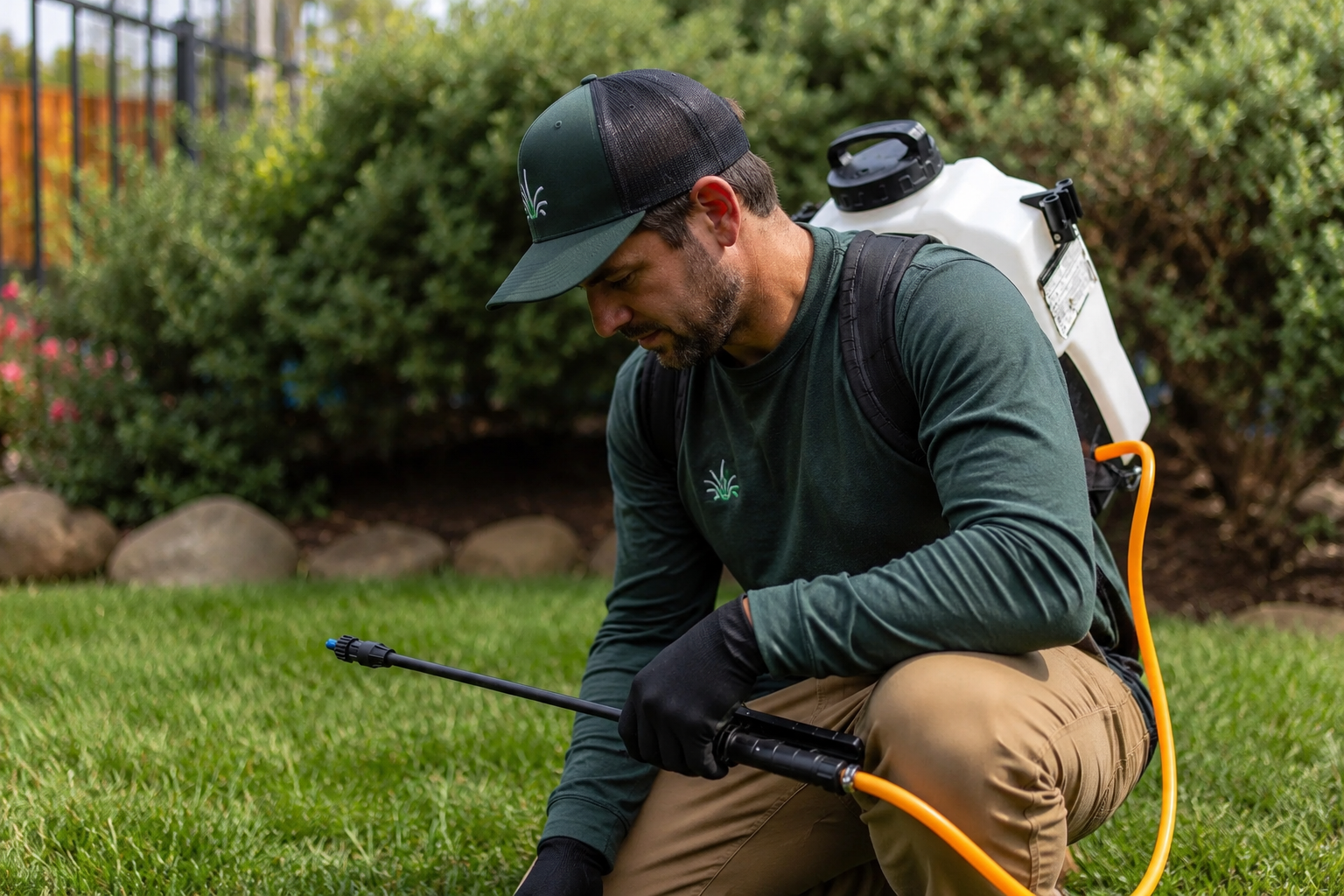
Backpack sprayers are common for spot treatments, small properties and detail work around ornamentals. Their application rate depends heavily on the technician’s walking speed, swath width, pressure consistency and trigger operation. The technician who calibrates the backpack sprayer should ideally be the person using it in the field.
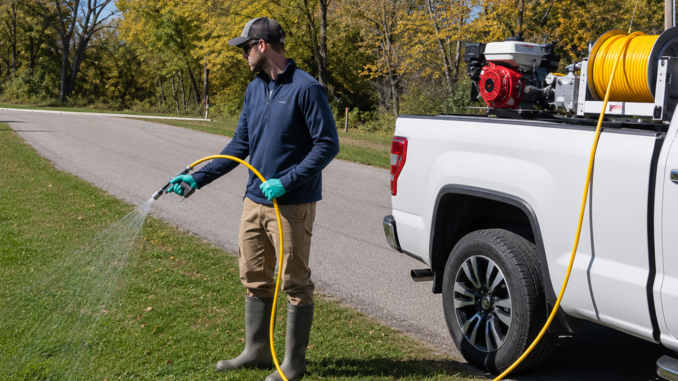
Hose-reel, skid-mounted and truck-mounted sprayers are widely used for larger lawn care routes. These units can provide higher capacity and more consistent pressure, but they still require regular checks of flow meters, pumps, hoses, reels, regulators and nozzles. A truck-mounted rig that applies the correct rate in the morning can drift out of specification after a nozzle change, damaged hose, clogged filter or pressure problem.
Boom sprayers are suited to broad, uniform turf areas because each nozzle covers a defined section of the boom. Granular spreaders work differently but need the same discipline. The objective is to confirm how much product leaves the spreader across a known area, then adjust the gate setting, travel speed or overlap pattern until the measured output matches the intended rate.
Using a 1,000-Square-Foot Test Area
A Practical Turf Calibration Method
The 1,000-square-foot method is useful for lawn care because many turf products are labeled or sold with rates expressed per 1,000 square feet. Measure and mark a test area that equals 1,000 square feet. A rectangle measuring 20 feet by 50 feet is one simple example. The test area should be level enough to allow the technician to travel at the same pace and use the same equipment settings expected during the actual application.
Fill the sprayer with water, set the pressure and nozzle configuration, then operate through the test area exactly as the technician would on a customer property. Measure the volume used to complete the pass. That measured amount represents the spray volume being applied per 1,000 square feet under those conditions.
Repeat the process to confirm the result. If the sprayer applies too much or too little, adjust one operating factor at a time. A change in walking speed, nozzle size, pressure or swath width can alter the final rate. After making an adjustment, repeat the test rather than assuming the change produced the intended result.
Applying the 1/128-Acre Method
Converting Ounces Directly to GPA
The 1/128-acre method is a well-established shortcut for calibrating broadcast sprayers. One acre is 43,560 square feet, which means 1/128 of an acre equals approximately 340 square feet. Because one gallon contains 128 fluid ounces, the number of ounces collected or applied over a 1/128-acre test area directly equals the gallons per acre rate.
For a backpack sprayer, first determine the effective swath width. Then mark a test course that, when multiplied by the swath width, equals approximately 340 square feet. Walk the course at a normal field pace with normal pressure and spray technique. Measure the ounces used or collected for that pass. If the measured amount is 25 ounces, the application rate is 25 GPA.
This approach is particularly helpful because it measures the system under realistic operating conditions. It captures the technician’s walking speed, nozzle pattern and application technique, rather than relying on a theoretical setting. The Penn State 1/128-acre calibration method provides additional detail on this direct ounces-to-GPA conversion.
Calibrating a Boom Sprayer
Calculating Output From Speed and Nozzle Flow
A boom sprayer can be calibrated using nozzle flow, operating speed and nozzle spacing. The standard formula is GPA = (GPM × 5,940) ÷ (MPH × W), where GPM is the flow rate per nozzle, MPH is travel speed and W is nozzle spacing in inches. This formula helps contractors estimate application rate, but it should be verified with an actual field check.
Start by inspecting strainers, filters, hoses and nozzles. Run clean water through the system at the intended operating pressure. Collect the output from each nozzle for the same amount of time, usually one minute, and compare the measurements. Significant differences between nozzles can indicate wear, damage or blockage. Replace or clean components as needed, then recheck the set.
Next, measure real ground speed using the same vehicle, load and terrain conditions expected in the field. Relying on a dashboard reading alone can introduce error. Once the nozzles, pressure, spacing and speed have been checked, calculate the expected GPA and verify it by spraying a measured area or measuring tank drawdown.
Calibrating Granular Spreaders
Granular spreader calibration requires a known area and a measured quantity of product. Begin with a clean, properly maintained spreader and select a test area with a known square footage. Weigh the product before application, make the pass using the intended gate setting and overlap pattern, then weigh the remaining product. The difference is the amount applied to the test area.
Convert that amount to the label’s required rate per 1,000 square feet or per acre. If the application rate is not correct, adjust the spreader setting and repeat the test. Spreaders should be calibrated with the actual product being used because particle size, density and flow characteristics can vary among formulations. A setting that works for one granular product may not provide the same output for another.
When to Recalibrate Equipment
Calibration should be repeated whenever the operating conditions change. This includes installing new nozzles, changing nozzle types, changing the product or carrier, adjusting pressure, repairing the pump or plumbing, changing spreader product, modifying boom configuration or assigning a different technician to a backpack unit. Regular recalibration is also appropriate during the season because nozzles and mechanical parts wear over time.
A technician should not wait for obvious streaking, customer complaints or unexpectedly high product use before checking the system. Routine checks help identify problems before they affect an entire route. Calibration records also help managers compare equipment performance across crews and identify recurring maintenance issues.
Daily Field Checks and Recordkeeping
Before leaving the yard, technicians should inspect tanks, lids, hoses, fittings, strainers, nozzles, pressure gauges and controls for leaks, clogs, damage or irregular operation. They should confirm that the correct product, label instructions, personal protective equipment and measuring tools are available for the day’s work. During applications, technicians should maintain consistent travel speed, pressure and overlap while watching for changes in spray pattern or equipment performance.
Application records should document what was applied, where it was applied, the date, the rate, the equipment used and any other information required by the product label or applicable state and local rules. Good records improve route management, support customer communication and provide a useful reference when troubleshooting an application. In professional lawn care and pest control, calibration is not simply an equipment task. It is part of delivering accurate, repeatable service on every property.

Why is sprayer and spreader calibration important in lawn care?
Calibration ensures products are applied at the correct rate, improving effectiveness, reducing waste, and helping contractors comply with label requirements.
How often should lawn care equipment be recalibrated?
Equipment should be recalibrated whenever nozzles, products, pressure, settings, or operators change, and checked regularly throughout the season.