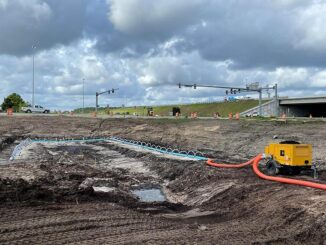







































Deep excavations and flood response do not fail because nobody owned a pump. They fail because the water volume, head, discharge path, and fuel plan were never treated as one system. A single trailer that looked heroic on a shallow sump becomes a spectator when the cut goes deeper, the river comes up, or three open pumps fight each other for the same choked discharge.
This guide is about planning a high-volume dewatering spread for deep excavations and flood response: parallel capacity, discharge routing and energy control, fuel and runtime math, monitoring, and when wellpoints or other groundwater control beat open pumping. It assumes you already understand basic single-pump suction discipline—and need the scale plan that keeps the site ahead of the water.
Define the Spread Before You Count Trailers
Start with a written water budget, not a shopping list:
- Inflow scenarios—expected seepage into the excavation, design storm or river stage for flood work, and the “worse but credible” case your superintendent will actually face.
- Drawdown target—how low the water must stay for slopes, structures, or recovery access—and how fast you must get there after a surge.
- Head profile—static lifts from the lowest sumps to the highest discharge points, plus friction for the hose and pipe diameters you can really stage.
- Discharge constraints—permitted outlets, maximum velocities, sediment controls, and places you cannot erode or re-flood.
- Runtime—hours of continuous duty, fuel logistics, staffing, and what happens when one unit is down for service.
Convert that budget into flow (gpm or cfs) at a stated TDH. Then decide how many units, of what solids-handling capability, deliver that flow with margin when one machine is offline. Peak nameplate flow at zero head is not a spread plan.
Deep excavations often need staged sumps as the cut deepens. Flood response often needs rapid deployment, dirty water tolerance, and discharge into already stressed drainage. Same physics—different mobilization clocks and failure modes.
Parallel Capacity Beats One Giant Bet
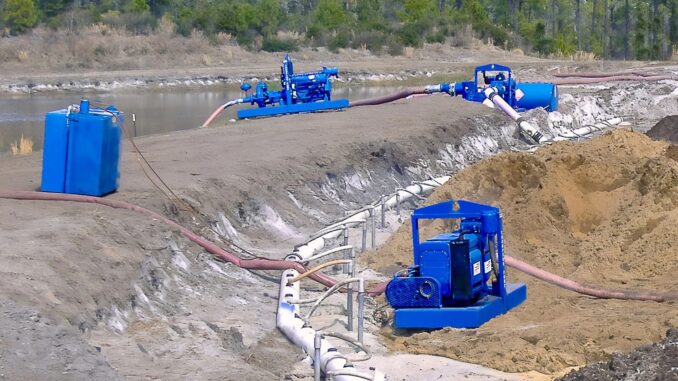
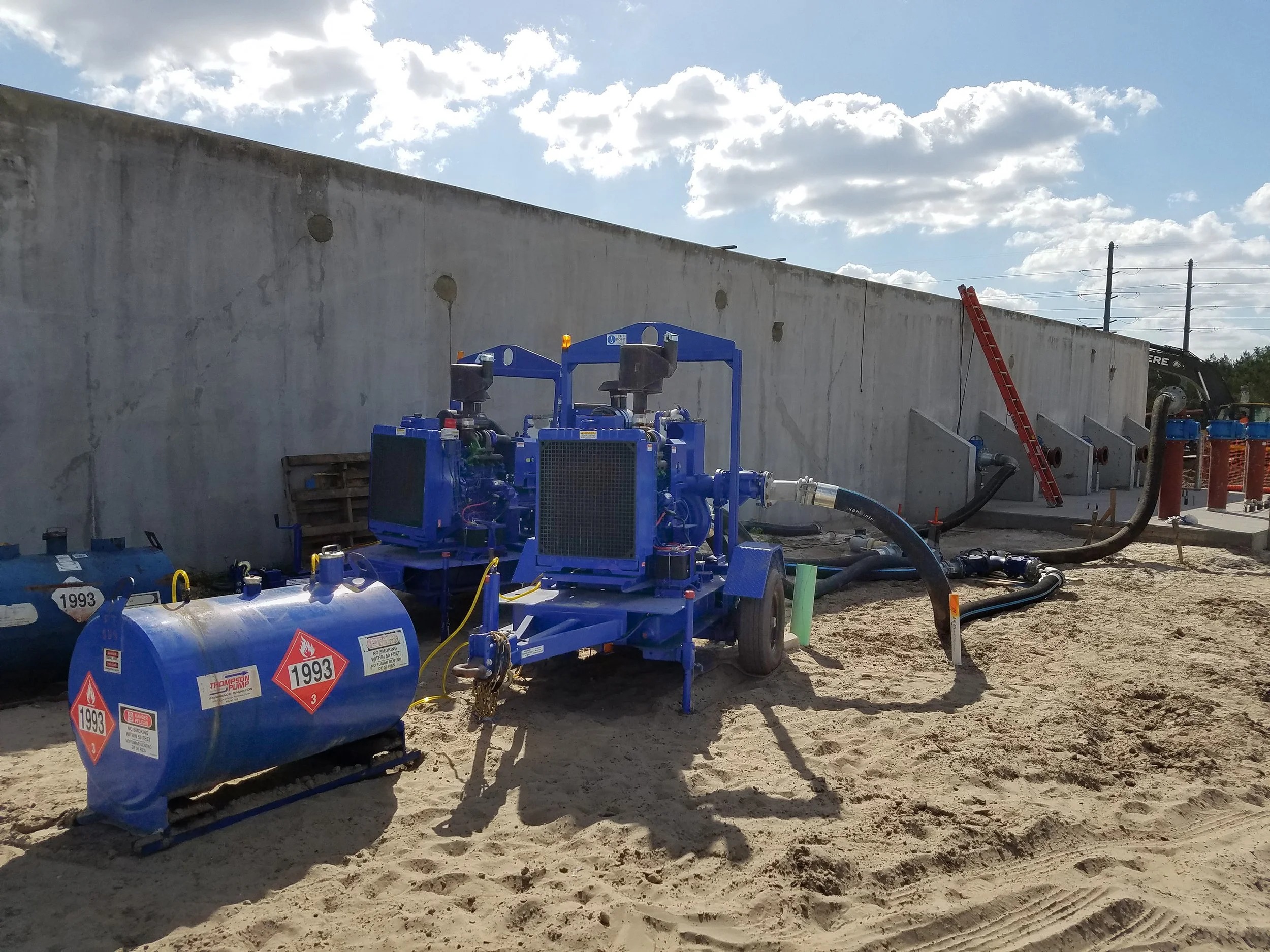
High-volume spreads usually win with parallel pumps—not one enormous unit that cannot be moved, fueled, or repaired when it matters. Parallel layouts let you match running capacity to the current inflow, keep a spinning or staged reserve, and isolate a unit without killing the whole system.
Series pumping (boosting from one pump into another) shows up when a single stage cannot make the head. Treat series as an engineered exception: matching flows, protecting against dead-head and reverse flow, and briefing operators so nobody “helps” by throttling the wrong valve. Most excavation and flood spreads stay in parallel with adequate discharge diameter and honest head numbers.
Hose and header sizing matter as much as pump count. Undersized shared discharge turns three healthy pumps into one mediocre system fighting friction. Plan manifolds, check valves, and isolation so you can pull a unit without draining the header into the excavation.
Discharge Routing and Energy Dissipation
Moving a lot of water is easy to celebrate and hard to land safely. Map the full path from sump to approved outlet:
- Elevation and supports—high points, soft spots where hose will sag and pull couplings, and vehicle crossings that need ramps or burial.
- Velocity at the outlet—use splash plates, stilling basins, riprap, or diffuser bags so the discharge does not cut a new channel into the berm you need.
- Sediment and quality—settling, filtration, or other controls required by the permit before water leaves the site.
- Short-circuit risk—discharge that re-enters the cut, undermines the access road, or floods the only fuel staging area.
On flood sites, coordinate with incident command on where water is allowed to go. On deep civil cuts, coordinate with the geotech and superintendent so drawdown and discharge do not fight the slope design. The spread is part of the earthwork plan—not a side show next to it.
Fuel, Runtime, and Monitoring
High-volume duty is a logistics problem dressed as hydraulics. Calculate fuel burn at the expected load for every running hour in the worst multi-day window, then add margin for delays in refueling access. Stage tanks with spill control, keep suction hoses out of traffic, and assign who refuels at night when the excavation cannot wait for daylight paperwork.
Monitoring should be boring and frequent: sump levels, discharge clarity and landing, oil pressure and temperature, fuel rate, and whether parallel units are sharing load as intended. Level alarms and auto-start help only if someone still owns the response. Flood spreads often need a dedicated watch; deep excavation spreads need a written overnight check even when “it was fine at quitting time.”
Heavy-duty pump makers that support construction and emergency work—such as Thompson Pump—publish curves, solids-handling data, and application notes that belong in the spread worksheet next to your hose inventory. Spec from duty and TDH; mobilize from a checklist, not from memory of last year’s storm.
When Wellpoints Beat Open Pumping
Open sump pumping fights water after it enters the cut. Wellpoint and related groundwater-control systems lower the water table before or as you dig, which can stabilize slopes, reduce boiling, and cut the volume you must move with trash pumps. They shine in permeable soils where a header and point spacing can create a coherent cone of depression.
Open pumping still wins for stormwater, floodwater, and dirty inflows that are not a controllable water table—or when you need immediate capacity while groundwater control is being installed. Many deep sites use both: wellpoints or deep wells for groundwater, and open trash capacity for rainfall and construction water. Choose based on soil, depth, and inflow type—not on which trailer arrived first.
Spread Commissioning Checklist
- Confirm flow/TDH targets and the offline-unit margin in writing.
- Pressure-test or carefully commission suction and discharge joints under load.
- Verify manifold isolation, check valves, and the procedure to swap a unit.
- Walk the full discharge path to the approved outlet; fix erosion and crossing hazards before nightfall.
- Stage fuel, spill kit, spare couplings/gaskets, and a spare pump or clear rental ETA.
- Set level monitoring and the call tree; run a shift handoff with photos of the layout.
- Re-check after the first major inflow event—spreads drift as hoses move and sumps migrate.
Keep a living drawing of the spread—even a marked-up site plan—showing pump IDs, hose diameters, manifold valves, fuel locations, and discharge outlets. When the night crew inherits three look-alike blue trailers and a snake pit of camlocks, labels and a one-page map are what keep the wrong valve from being closed “to stop a leak” while the excavation fills.
After demobilization, capture what actually ran: which units carried load, where hose failed, how often fuel turned critical, and whether the offline margin was real or optimistic. That after-action note is the cheapest engineering for the next deep cut or the next flood call.
If the excavation deepens mid-project, revisit the spread the same day the cut changes—not after the first overnight refill. Head and sump geometry shift with every lift of dirt leaving the hole.
Final Thoughts
A high-volume dewatering spread is a system: parallel capacity sized to real inflow and head, discharge that lands without creating new damage, fuel and monitoring that survive multi-day duty, and a clear call on when groundwater control should replace or supplement open pumping. Deep excavations and flood response punish improvisation at scale. Plan the water budget, build the spread for the unit that will be down, and keep the site ahead of the water—not behind it with more hose and hope.