








Slipform machines pour curb, gutter, and lane pavement at a pace fixed forms cannot match on a long, open run. That productivity is real—and it is why most mainline concrete paving travels behind a stringline and an extrusion pan. It is also why crews lose money when they force a slipform train into short pours, tight radii, utility mazes, or finish specs that need forms as rails.
This guide is about choosing the method that matches length, geometry, access, and edge quality—not defending a favorite machine.
Two Ways to Hold Concrete on Grade
Slipform paving extrudes concrete through a moving mold. Sensors follow a stringline or 3D model for line and grade. There are no edge forms left behind the machine; the mix must stand on its own after the pan passes. Modern curb-and-gutter slipformers and full-width pavers excel when the alignment is continuous and the site gives the machine room to work.
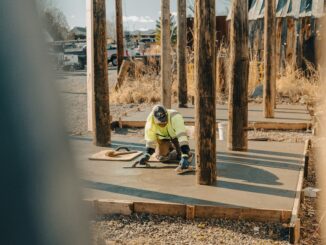
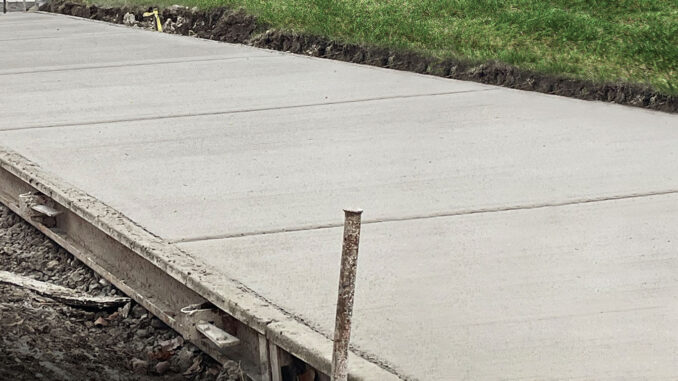
Fixed-form paving sets steel (or other reusable) side forms to the required elevation and alignment before the pour. Forms hold plastic concrete to thickness and line while vibrators, strike-offs, and screeds work between them. On many jobs the forms also become the rails for a vibrating truss or roller screed. After initial set, crews strip, clean, and reuse the forms.
Both methods can meet municipal and site specs. The wrong choice shows up as idle machine time, hand-patched radii, blowouts, wavy edges, or a finish that never matches the drawing.
When Slipform Is the Right Call
Reach for slipform when the production math is honest:
- Long, continuous alignment—collector streets, highway lanes, airport taxiways, and long curb runs where stringline or model control stays productive.
- Open access—room for the paver, trucks, and support crew without constant tear-down for driveways, valves, or parked obstacles.
- Repeatable cross-section—standard curb-and-gutter or uniform slab depth where changing molds mid-day costs more than it saves.
- Crew and mix ready for extrusion—low enough slump to hold an edge, vibrators tuned, and a finishing train that keeps up with the pan.
On those days, fixed forms are the slower path. Mobilizing a slipform package and then chopping the pour into disconnected panels wastes the machine’s advantage.
Setup Time: Fixed Forms Aren’t Always the Slow Path
“Forms take longer” is true only when you compare a continuous slipform day to a form-setting day of equal length. Short municipal patches, driveway returns, alley panels, and commercial flatwork often flip the equation.
Fixed-form crews win setup-time arguments when:
- Pour length is short—setting a few hundred feet of forms can beat mobilizing, stringlining, and demobilizing a slipformer for a handful of panels.
- The machine would idle—utility conflicts, phased traffic, or waiting on trucks erase slipform production faster than form stakes ever will.
- Equipment cost dominates—small crews without a curb machine (or without a rental window that fits) still place quality concrete with forms, a screed, and disciplined staking.
- Geometry keeps changing—variable widths, tapers, and islands make mold changes expensive; forms adjust section by section.
Count total crew-hours from grade ready to traffic-ready edge—not just concrete cubic yards per hour while the pan is moving. Idle slipform time is still on the estimate.
Radius Work, Islands, and Utility Conflicts
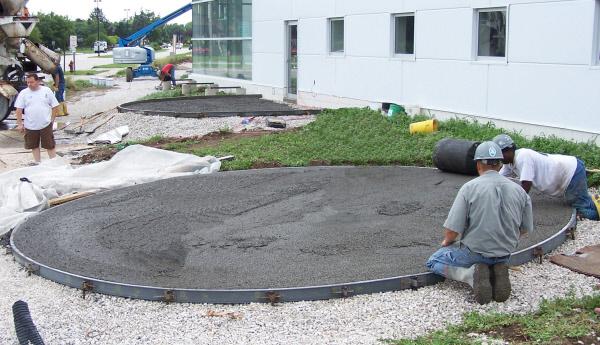
Tight radii expose slipform limits quickly. Machine turning radius, sensor lag, and mix “stand-up” all fight a clean curve. Circles, cul-de-sac returns, median noses, and landscape islands routinely go to flexible or curved metal forms so the edge matches the layout—not the machine’s minimum radius.
Fixed forms also absorb the interruptions slipform hates:
- Valve boxes, manholes, and light bases that break the stringline rhythm
- Driveway cuts and tie-ins that need handwork anyway
- Restricted right-of-way where a paver footprint does not fit
- Match lines against existing curb where a short formed segment is cleaner than a machine pass and a rebuild
A practical field rule many paving references still use: curves under about 100 feet of radius usually need flexible or purpose-bent forms rather than straight 10-foot steel laid as a polygon. Stake as you bend, keep joints off the apex of the curve, and verify the stringline or template before the first truck.
Finish Specs: Forms as Grade Rails
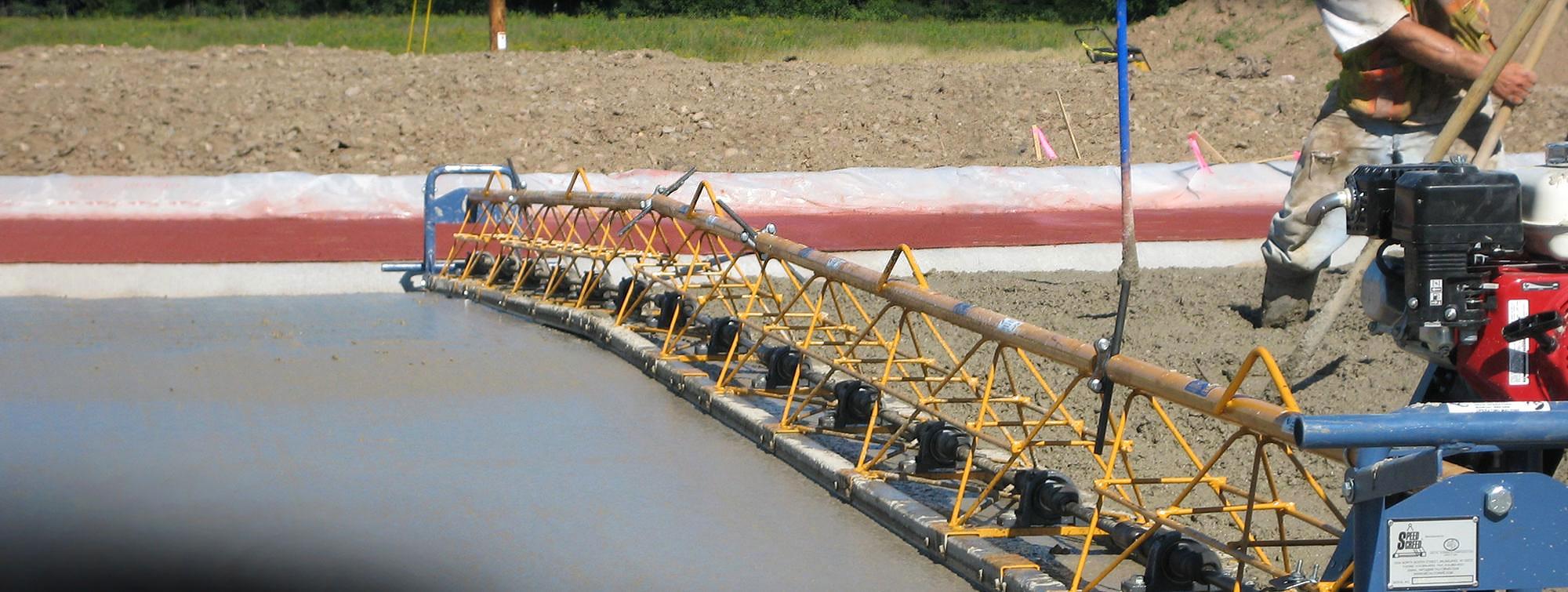
Finish quality is not only a float pass. On formed pavement, the top of the form is often the reference the screed rides. If forms wave, the surface waves. If forms settle under the screed, the crown or cross-slope drifts.
Protect the finish spec with form discipline:
- Elevation first—set forms to the same control network the inspector will use; check after staking and again before concrete.
- Bracing against blowout—stake spacing, wedges, and kickers matched to pour height and slump; tall curb and header forms need more than “looks solid.”
- Joint plan before the pour—contraction and construction joints land on purpose, not wherever the crew got tired.
- Screed match—vibrating truss, roller, or hand strike-off chosen for width, slump, and thickness; keep a consistent surcharge ahead of the screed.
- Edge and face finish—tool the face while the mix supports it; stripping too early scars the edge you just paid to form.
On flat pavement and wide panels, form-riding screeds turn accurate forms into production finish tools. That is a different workflow than boom laser flatwork indoors—but the same idea holds: grade control upstream beats grinding downstream.
Form Setting Habits That Keep Municipal Work on Grade
Whether you pour sidewalk, curb and gutter, or a short street panel, the checklist stays simple:
- Grade and subbase ready—forms cannot hide soft spots or waves in the base.
- Line and elevation locked—stringline, laser, or total station checked against benchmarks.
- Connections tight—hinge or plate ends flush so the screed does not bump every joint.
- Stake and wedge discipline—enough support for the pour height; recheck after the first truck vibration.
- Strip, clean, oil, stack—reuse life is part of the cost model; bent, concrete-caked forms fight the next layout.
Reusable steel flatwork and paving form systems—and flexible-radius curb assemblies—from suppliers such as Metal Forms exist so crews can reset accurate edges without buying lumber every week. The hardware only helps if staking and elevation checks stay non-negotiable.
A Practical Decision Snapshot
Site condition |
Lean toward |
|---|---|
Long continuous curb or lane, open access, standard section |
Slipform |
Short panels, patches, phased traffic, small crew |
Fixed forms |
Tight radii, islands, circles, variable width |
Fixed / flexible forms |
Heavy utility conflicts and frequent stop-start |
Fixed forms (or hybrid) |
Finish needs form-riding screed rails and crisp edges |
Fixed forms + matched screed |
Mainline production where machine utilization stays high |
Slipform |
Many successful jobs are hybrids: slipform the long tangent, form the returns and islands, and refuse to apologize for either method. Specs care about line, grade, and durability—not which catalog page you poured from.
Bottom Line
Slipform wins on length, continuity, and machine utilization. Fixed forms still win on setup-time reality for short and interrupted work, on radius and custom geometry, and whenever the finish spec depends on forms as accurate rails. Choose the method that keeps concrete moving and the edge true—then build the estimate around that choice, not around the brochure photo of the bigger machine.