


















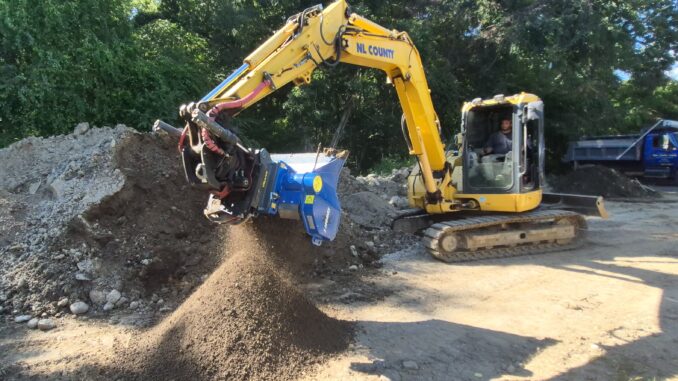
STONINGTON, Conn.: For years, Jake Willis of New London County Septic & Excavation (NLCSS) ran his excavation projects the way most contractors do: strip the topsoil, haul it offsite to a processor, and truck screened material back in. Today three excavators equipped with Gyru-Star compact screening buckets produce clean topsoil on the job site. The result is fewer trucks, lower material costs, and higher productivity. Jake estimates the first bucket paid for itself in a couple of months, and even his technology-wary father, Todd, is now a believer.
The Way Things Were
Jake and his father run the Connecticut-based company, which was founded in 2013. Its primary work is septic, sewer, and excavation. About 85% of the jobs are residential – mostly single-family home lots, and roughly 15% is commercial.
The terrain in this part of New England is unforgiving. Hardpan, ledge, and glacial erratics dominate the region. One site can have clean soil, while the next is littered with five-yard boulders. It is hard digging that is rough on machines and attachments alike.
Before screening on site with the Gyru-Star buckets, NLCSS’s process was expensive and slow. Crews stripped the topsoil, and either spread it out and raked it with a skid-steer power rake, or transported it to local yards for screening and backhauled the finished product. Pipe work added more labor since crews hand-shoveled bedding around the pipe and fought rocks that rolled down the trench wall.
The cost was folded into the job price, so it never looked like a problem. But it meant a lot of trucking, extensive waiting, and double-handled material. “We simplified the entire operation into one process with one bucket,” Jake says.
Gyru-Star for Every Excavator
NLCSS’s fleet is built around quick-change technology. Every excavator carries an OilQuick quick coupler and a tiltrotator, so attachments can be swapped from inside the cab within seconds and no hydraulic lines to connect.
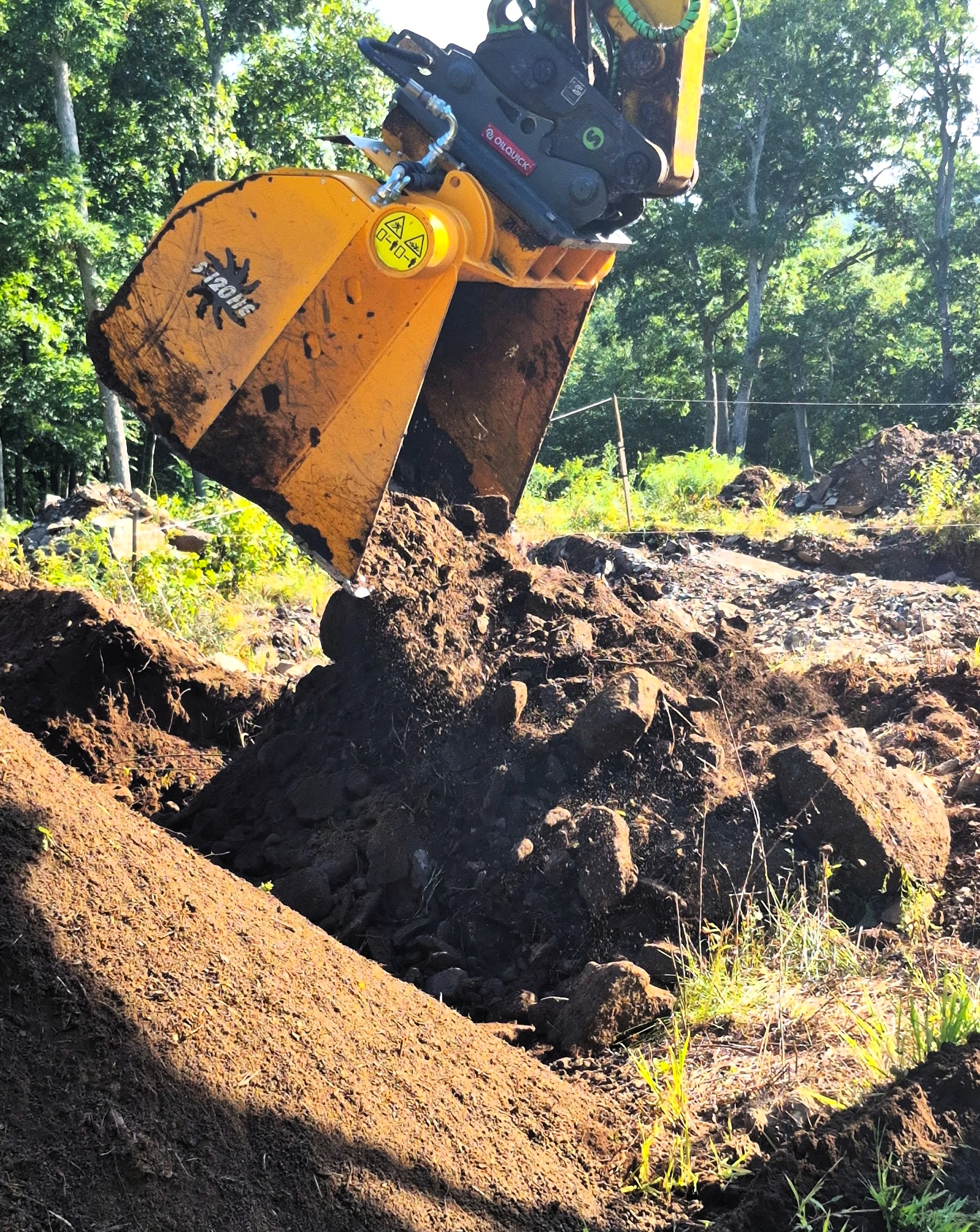
Each Gyru-Star bucket is assigned to its own excavator. The Gyru-Star 3-100HE and a 3-100MAX are used on two Komatsu PC88s, both of which are equipped with Rototilt tiltrotators. The 5-120HE is mounted on a Komatsu PC138 with a Steelwrist tiltrotator. NLCSS bought the 3-100HE around 2021, the 5-120HE last year, and the 3-100MAX in the summer of 2026. The 3-100MAX is the first in use in the United States.
Generational Divide
Jake is an early adopter of new technologies, while Todd is skeptical. The two crossed that bridge early on with tiltrotators. Jake’s persistence led to Todd recognizing the value of adoption.
The screening bucket followed the same path. Jake made the case with numbers, telling his father it could pay for itself in three or four jobs. Today his father is as convinced as he is.
Making the Switch
NLCSS bought all three Gyru-Star buckets through Eric Ransome of New Jersey-based Ransome Attachments. Jake met Eric at a forestry trade show in Vermont in 2016. His level of trust was built after acquiring another attachment that paid off for his firewood business – the Black Splitter cone splitter.
Jake first noticed screening buckets when a local site contractor on a subdivision job ran one on a large excavator. Two weeks later, an email arrived from Eric, announcing the new Gyru-Star line. He offered to send a bucket up for a demo, and that was the end of the evaluation. “I’m not returning this bucket,” Jake told Eric.
The demo format suited Jake. Because his OilQuick couplers do not match the standard pin-grabber heads and hydraulic lines most attachments include, he cannot simply buy attachments sight unseen. He needs a dealer willing to ship a bucket, build a matching head, and allow him to test it for an extended period.
Jake and Todd evaluated the return on investment carefully up front. “We looked at the cost of the bucket, and then we broke down the price of the topsoil we were purchasing,” he recalls. “Then we ran some more numbers and realized quickly that it (Gyru-Star) was going to pay for itself within a couple months.”
Pipe Bedding and Topsoil Screening
Pipe bedding is the main screening application for NLCSS. Many local municipalities require six inches of bedding below water and sewer pipes and a foot above it. Instead of importing pipe sand, they now make it on site using the Gyru-Star. Nothing leaves the site and no fill is lost. Because the bucket goes on and off in about 30 seconds, it is worth using even on smaller trenches.
“Instead of using rocky fill to backfill around the pipe and removing rocks by hand, you just put on the (Gyru-Star) bucket for two seconds and screen in six to eight inches of pipe cover,” Jake says. “I honestly think you can give your customers a better quality product as well by better protecting the pipe.”
Topsoil is the second big win. Crews used to haul out 40 to 50 yards and bring about the same amount back on a typical job. Now nearly all of it stays put, and NLCSS may import only two or three yards to fine-tune the finish. Tailings can go into on-site burials as fill, or be hauled offsite if the job has surplus.
Production Rates
Production depends heavily on the material being screened. The 3-100 handles roughly 30 to 35 tons an hour, and as much as 40 to 45 with dry, silty material. The 5-120 can screen up to 120 tons an hour with dry material.
Jake is candid that these figures trail large screening plants. “It’s (Gyru-Star) not something you’re going to put on a 40-home subdivision site,” Jake says, “but they really shine in the landscaping, small excavating, and cross-country pipeline worlds.”
Durability in Punishing Ground
Skeptics sometimes question how the Gyru-Star’s polyurethane screening stars hold up in rocky conditions. Last winter, NLCSS’s mechanics took advantage of downtime to replace all the stars on his four-year-old 3-100. Aside from a handful of damaged fingers, the stars showed little to no wear.
He kept the old shafts to build spares later. The swap used complete shaft assemblies from Ransome Attachments, and despite a warning that the job was involved, his mechanics finished it in a day.
The real enemy, Jake says, is roots rather than rocks. Rocks float and bounce on the stars, while roots can sometimes wrap like rope and saw off the fingers.
The Power of Onsite Screening
For Jake, the benefit goes beyond cost savings. Eliminating the trucking, screening plant, extra machines, manpower, downtime, and material orders means the job moves at the pace of the crew.
“With the Gyru-Star, you’re not hauling stuff out to haul stuff back in,” he says. “You can just make your own material on site.”
Jake recommends the bucket to everyone he meets, and he has the best possible reference at home: a father that once doubted every new attachment and now wonders why anyone would choose a standard bucket over a Gyru-Star.