













Heavy equipment manufacturing has always depended on welding quality, speed, and structural reliability. As equipment sizes increase and tolerances tighten, manufacturers are under growing pressure to deliver consistent weld quality at higher production volumes. This shift has accelerated the adoption of welding automation, which is steadily replacing manual fabrication methods across many heavy manufacturing environments.
The Manufacturing Pressures Driving Automation
Rising Production Demands
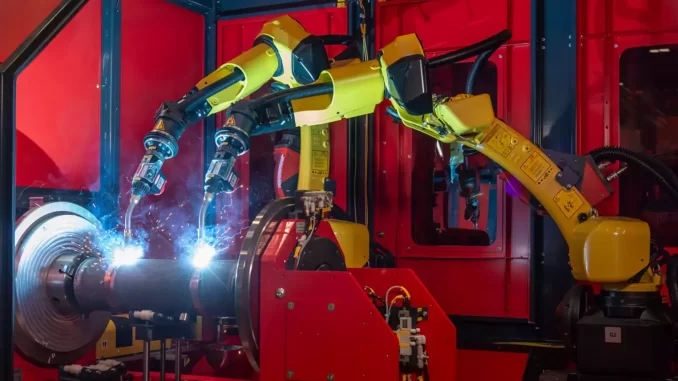
Heavy equipment fabrication involves repetitive welding on large structural components such as frames, booms, buckets, and support assemblies. Manual welding struggles to maintain consistent output at scale due to operator fatigue, shift variability, and skill differences. Automated welding systems address this challenge by operating continuously with stable parameters, allowing manufacturers to increase throughput without proportionally increasing labor hours. This production stability is one of the primary reasons manufacturers are investing in advanced welding automation solutions across fabrication facilities.
Consistency and Quality Requirements
Consistency is critical in heavy equipment manufacturing, where weld defects can lead to premature failure, costly repairs, or safety risks. Manual welding quality depends heavily on operator experience and focus, which can vary over long production runs. Automated welding systems use programmed settings that repeat the same weld parameters for every joint. This repeatability improves penetration consistency, bead appearance, and mechanical performance while reducing the likelihood of defects such as undercutting or lack of fusion.
Labor Availability and Safety Concerns
Skilled welding labor shortages are an ongoing challenge in many industrial markets. At the same time, welding remains a physically demanding and potentially hazardous task. Automation reduces worker exposure to heat, fumes, and arc radiation by shifting repetitive welding tasks to robotic or mechanized systems. Human operators increasingly move into supervisory, programming, and inspection roles, improving overall workplace safety while making better use of skilled labor.

How Welding Automation Outperforms Manual Fabrication
Precision Through Controlled Parameters
Automated welding systems deliver precise control over heat input, wire feed speed, travel speed, and arc stability. This level of control is difficult to sustain manually over long shifts or across multiple operators. In heavy equipment fabrication, where thick materials and high load conditions are common, precise parameter control directly affects weld strength and fatigue performance. Automation ensures each weld meets predefined specifications, reducing variability and improving overall product reliability.
Integration With Digital Manufacturing
Modern fabrication facilities increasingly rely on digital workflows that link design, simulation, and production. Automated welding systems can be programmed directly from digital models, allowing manufacturers to simulate weld paths and optimize parameters before production begins. This integration shortens setup times and reduces trial-and-error adjustments on the shop floor. Digital connectivity also supports documentation and traceability, which are becoming more important for quality assurance and regulatory compliance.
Reduced Rework and Material Waste
Rework is one of the hidden costs of manual welding. Inconsistent weld quality often leads to grinding, repairs, or component rejection. Automated welding reduces these issues by producing uniform welds that meet specifications on the first pass. Lower rework rates translate into material savings, reduced labor costs, and more predictable production schedules, all of which are critical in heavy equipment manufacturing.
Where Manual Welding Still Plays a Role
Complex and Low-Volume Fabrication
Despite the growth of automation, manual welding remains essential for certain applications. Custom fabrications, prototype components, and low-volume builds often require flexibility and real-time decision making that automated systems cannot easily replicate. Skilled welders continue to play a vital role in handling complex joints, fit-up challenges, and on-site repairs that demand adaptability.
Hybrid Fabrication Workflows
Many manufacturers are adopting hybrid workflows that combine automated and manual welding. In these environments, automation handles repetitive, high-volume welds while manual welders focus on specialized tasks and quality control. This approach allows manufacturers to maximize efficiency without sacrificing the craftsmanship needed for complex assemblies. Hybrid workflows represent a practical transition path for companies modernizing their fabrication operations.

The Business Impact on Heavy Equipment Manufacturers
Scalability and Cost Control
Welding automation enables manufacturers to scale production more efficiently. Once systems are installed and programmed, production increases do not require proportional increases in labor. Over time, the reduced labor dependency, lower rework rates, and improved material utilization contribute to lower cost per unit. For heavy equipment manufacturers operating in competitive markets, this cost control is a significant advantage.
Long-Term Operational Stability
Automation investments also support long-term operational stability. Consistent production output, predictable quality, and reduced reliance on scarce labor help manufacturers manage risk and plan capacity more effectively. As equipment designs evolve and production volumes fluctuate, automated welding systems offer the flexibility to adapt through reprogramming rather than extensive retraining.
The Future of Welding in Heavy Equipment Manufacturing
Continued Growth of Automated Systems
Industry trends indicate that welding automation will continue expanding across heavy fabrication environments. Advances in sensors, controls, and software are making automated systems more capable of handling varied joint geometries and material thicknesses. As these technologies mature, automation will move beyond repetitive welds into increasingly complex applications.
Supporting Quality and Innovation
As manufacturers focus on durability, performance, and lifecycle value, welding quality remains a central concern. Investment in high precision welding systems supports these goals by delivering consistent results that align with modern manufacturing standards. Automation is not eliminating skilled welders but redefining how welding expertise is applied within advanced fabrication environments.
The shift from manual welding to automation reflects a broader transformation in heavy equipment manufacturing. By embracing controlled, repeatable, and scalable welding processes, manufacturers are positioning themselves to meet future production demands while maintaining the structural integrity and reliability their equipment requires.
Why are heavy equipment manufacturers adopting welding automation?
Welding automation improves consistency, productivity, and safety while reducing labor dependency and rework.
When is manual welding still necessary in heavy equipment fabrication?
Manual welding is used for low-volume, custom, or complex components that require operator flexibility and precision.