






















Construction projects often encounter obstacles that complicate the movement of heavy equipment. Streams, drainage ditches, underground utilities, and uneven terrain can force contractors to take lengthy detours or develop additional access routes. Temporary bridges provide an alternative by establishing designated crossings without requiring permanent infrastructure. Advances in engineered materials, including cross-laminated timber (CLT) and structural steel, have expanded the options available for portable, reusable bridge systems.
Why Temporary Bridges Are Important for Construction Site Access
Maintaining reliable site access is essential for construction operations involving excavators, loaders, cranes, and material transport vehicles. When obstacles interrupt established routes, equipment operators may need to travel considerable distances between work areas, increasing travel time and operating costs.
Temporary construction bridges address these challenges by creating crossings designed for specific equipment loads and site conditions. They are particularly useful for projects where permanent bridges are unnecessary or economically impractical.
These structures can also help contractors limit ground disturbance. Rather than placing fill directly into a stream or excavating around buried infrastructure, an engineered bridge can span the obstacle while transferring loads to designated support locations. However, environmental permits and engineering approvals may still be required depending on the location and installation method.
Types of Temporary Bridges Used in Construction
Several temporary bridge systems are available, with differences in structural materials, installation requirements, and load-bearing capabilities.
Timber Mat Bridges
Traditional timber mat crossings use heavy wooden mats arranged to create temporary access routes. These systems are commonly associated with construction access, pipeline projects, and ground protection applications.
Their suitability depends on timber condition, structural configuration, span length, and anticipated loading. Properly engineered timber mat crossings can accommodate substantial loads, but contractors must verify the capacity of the complete assembly rather than relying on individual mat specifications.
Steel Temporary Bridges
Steel bridge systems use structural members designed to transfer loads across designated spans. Depending on their configuration, they can accommodate heavy construction equipment and repeated vehicle movements.
Transportation and installation requirements vary with bridge size, weight, and assembly method. Larger systems may require additional lifting capacity or specialized handling equipment.
Cross-Laminated Timber and Steel Bridges
Engineered temporary bridges can combine CLT decking components with structural steel supports. These systems use manufactured timber panels to establish the crossing surface while steel members provide structural support.
Such configurations can offer reusable access solutions with documented load ratings for specified bridge arrangements. However, their suitability must be evaluated against actual equipment loads and site conditions.
How Cross-Laminated Timber Bridges Work
Cross-laminated timber is an engineered wood product manufactured by bonding layers of lumber with adjacent layers oriented perpendicular to one another. This arrangement produces structural panels with predictable engineering properties when manufactured and designed according to applicable standards.
In temporary bridge applications, CLT panels can form part of the decking or bearing system. Structural steel components provide additional support, allowing the assembled structure to span obstacles while accommodating specified vehicle loads.
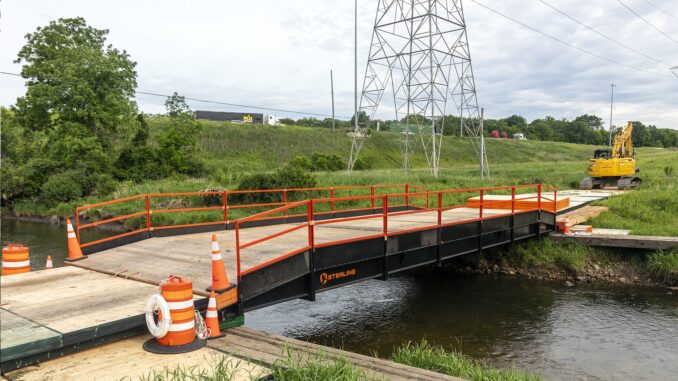
One example is the TerraCross temporary bridge system from Sterling Solutions. The system combines engineered steel components with Sterling’s TerraLam CLT mats.
According to Sterling, TerraCross incorporates TerraLam 500 bearing mats for foundational support and TerraLam 700 decking mats to establish the crossing surface. These components form part of the engineered bridge configuration and must be installed according to the manufacturer’s specifications.
Understanding Load Capacity and Span Requirements
Selecting a temporary bridge requires more than comparing equipment operating weights against a manufacturer’s advertised capacity. Contractors must evaluate the complete loading arrangement and the physical characteristics of the crossing.
Equipment Weight and Loading
Bridge selection should account for the total weight of equipment crossing the structure, including attachments, payloads, and transported materials. Axle loads, wheel spacing, track configurations, and concentrated loading can influence structural requirements.
Moving vehicles also introduce dynamic effects that must be considered during engineering evaluation. A bridge’s advertised maximum capacity should not be interpreted as approval for every equipment configuration.
Clear Span and Bridge Length
Clear span refers to the unobstructed distance between supporting locations. Overall bridge length includes the portions required to establish appropriate support beyond that span.
For example, Sterling offers TerraCross configurations with different dimensions:
Bridge Model |
Maximum Clear Span |
Overall Bridge Length |
|---|---|---|
TerraCross 40 |
35 feet |
40 feet |
TerraCross 56 |
50 feet |
56 feet |
According to Sterling Solutions, TerraCross configurations can accommodate loads of up to 100 tons and clear spans reaching 50 feet. Actual load limits depend on the selected bridge configuration and applicable engineering specifications.
Contractors should obtain documentation confirming that the proposed bridge can accommodate their specific equipment and loading conditions.
Installation Considerations for Temporary Construction Bridges
Ground Conditions and Bearing Support
Before installation, contractors must evaluate soil conditions, grades, and proposed bearing locations. Even when a bridge has sufficient structural capacity, inadequate ground support can compromise the crossing.
Depending on site conditions, additional bearing components, soil testing, or preparation may be necessary. The supporting ground must be capable of transferring the anticipated loads without excessive settlement or instability.
Equipment and Installation Time
Installation requirements depend on the bridge system and available construction equipment. Some portable bridges can be positioned using excavators or front-end loaders already operating on the jobsite.
According to Sterling Solutions, TerraCross can be installed using conventional construction equipment, with installation taking as little as two hours under ideal conditions. Actual deployment time depends on site access, terrain, soil conditions, and preparation requirements.
Sterling recommends installation by its field operations team. Contractor-led installation requires supervision from a Sterling site advisor.
Inspection and Operational Controls
Before opening a temporary crossing, contractors should verify that the installation meets the approved engineering requirements.
Operational planning should address equipment restrictions, traffic management, approach conditions, and periodic inspections. Any movement, damage, or deterioration affecting the crossing should be evaluated before continued use.
Temporary Bridges vs. Traditional Timber Mat Crossings
Traditional timber mat crossings and engineered temporary bridge systems serve overlapping purposes, but their structural characteristics and installation requirements can differ.
Consideration |
Timber Mat Crossings |
Engineered Temporary Bridge Systems |
|---|---|---|
Structural Configuration |
Depends on mat arrangement and crossing design |
Defined bridge assembly |
Load Capacity |
Requires evaluation of the complete crossing |
Based on engineering specifications for the selected configuration |
Materials |
Typically heavy timber |
May combine steel and engineered timber |
Installation |
Depends on crossing design and ground conditions |
Follows system-specific installation requirements |
Reusability |
Depends on material condition and handling |
Depends on design, condition, and maintenance |
Neither approach is universally appropriate. Contractors should compare verified structural capacity, installation costs, transportation requirements, environmental considerations, and anticipated project duration.
TerraCross: An Engineered CLT Bridge Solution
Sterling Solutions introduced TerraCross in May 2025 as a portable temporary bridge system for construction and development applications.
The system is designed for crossing waterways, drainage ditches, buried utilities, and other obstacles. Sterling also identifies applications involving existing bridges that cannot accommodate anticipated construction loads, subject to appropriate engineering evaluation.
According to the manufacturer, TerraCross 40 components can be transported on one standard flatbed truck, while TerraCross 56 requires two. The system is also designed for relocation and reuse across multiple projects.
A Residential Development Application
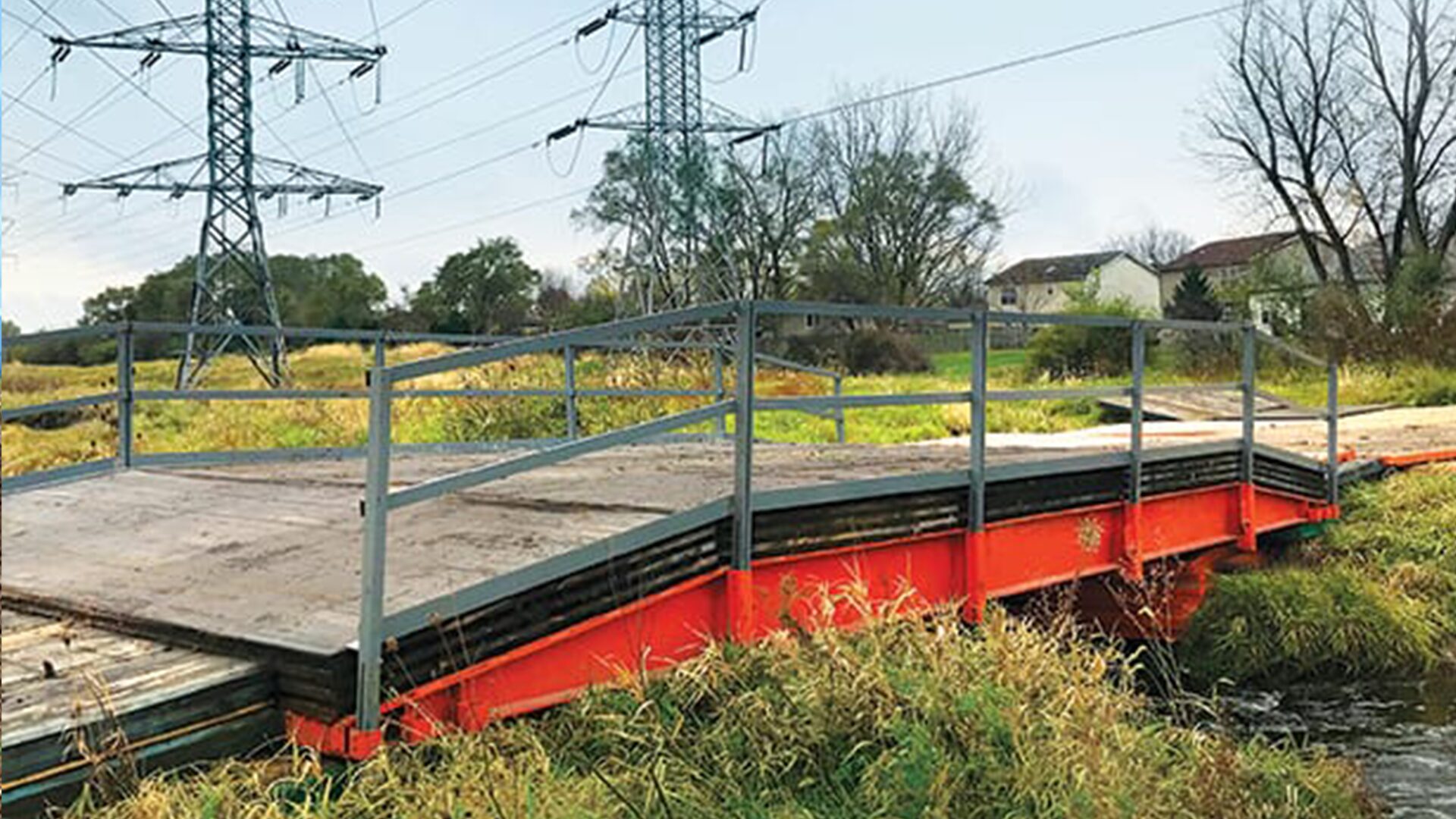
At Pine Meadows Reserve, a planned 240-acre residential development with 538 homesites, Sterling installed two TerraCross bridges side by side.
Each bridge measured 36 feet long and 18 feet wide, creating a two-lane crossing for heavy equipment.
Sterling reported that the installation reduced heavy-equipment travel distance by 80%. The developer also reported completing the project on schedule and within budget.
Although these manufacturer-reported results are specific to the development, the example illustrates how temporary crossings can improve equipment routing when obstacles separate active construction areas.
Choosing the Right Temporary Bridge for Your Project
The appropriate temporary bridge depends on equipment loads, required clear span, ground conditions, and duration of use. Contractors should obtain engineering documentation confirming the proposed configuration and its allowable loading before installation.
Transportation requirements, installation equipment, bearing preparation, and inspection responsibilities should also be established during project planning. Environmental considerations are particularly important when crossing waterways or sensitive areas, where permits or additional protective measures may be necessary.
Temporary bridges can provide practical solutions to construction access challenges that would otherwise require lengthy detours or more extensive site modifications. By evaluating structural capacity, site conditions, and installation requirements early, contractors can select crossings that support efficient equipment movement throughout the project.