






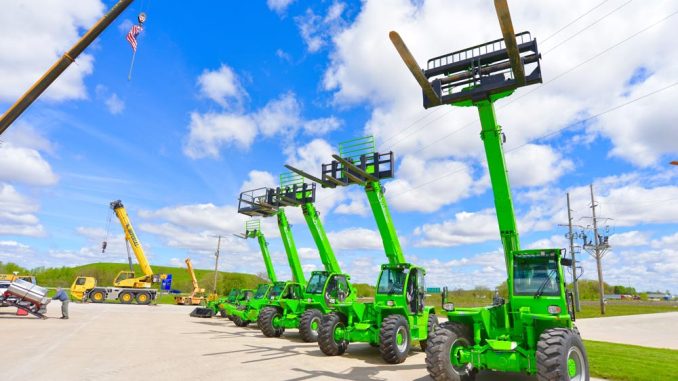
Telehandlers have become essential equipment across construction, industrial maintenance, utilities, and agriculture because they offer a combination of height, reach, power, and attachment flexibility that few machines can match. Their ability to lift, place, and transport materials in difficult environments has made them a core part of project planning for contractors who want to improve productivity and control costs. As telehandler demand continues to rise, many companies rely on trusted telehandler rental services to ensure they have access to the right model for each job.
Understanding Telehandler Functions
A telehandler is a telescopic material handler that blends characteristics of a forklift, crane, and loader. It features a boom that extends upward and forward to place loads at heights or distances unreachable by conventional forklifts. This makes telehandlers ideal for delivering materials to upper floors, loading roof structures, moving pallets across uneven ground, or placing loads over obstacles. Their reach advantage is significant because telehandlers can operate from safe ground positions while transferring materials to elevated locations, reducing reliance on additional lifting equipment in many scenarios.
Telehandlers are valued for their versatility. The boom can accept many attachments such as forks, buckets, work platforms, crane jibs, and winches, which transforms one machine into a multipurpose tool. Choosing the correct attachment is central to performance because load charts, forward reach, visibility, and stability can change depending on which tool is installed. Contractors benefit from understanding attachment capabilities so they can match the telehandler to the specific tasks required on each project.
Key Applications Across Industries
In commercial construction, telehandlers are widely used for transporting palletised materials such as bricks, block, roofing materials, lumber, and mechanical equipment. Their ability to deliver loads to elevated and lateral locations helps crews reduce manual handling and staging time. They serve as support equipment for many other operations including formwork installation, steel erection, and general material movement around congested jobsites.
Industrial plants and refineries rely heavily on telehandlers during maintenance shutdowns and turnarounds. These environments require lifting and placing pipes, valves, tools, and replacement components in areas where forklifts cannot operate due to space constraints or uneven surfaces. Telehandlers can operate safely in confined areas with proper planning, visibility adjustments, and stability checks, making them valuable for planned and emergency work.
Agriculture remains another major sector for telehandler use. Their height and reach allow farmers to load grain, lift feed bags, move bales, and service high sided trailers or hoppers. Bucket and grab attachments enable additional uses such as handling silage, manure, or mulch. Telehandlers have replaced multiple machines on many farms because a single unit can manage both lifting and loading operations throughout the year.

Selecting the Right Telehandler
Choosing a telehandler begins with determining the maximum load weight the machine must handle, followed by the highest elevation and furthest forward reach required. Load charts are essential because rated capacity decreases as the boom extends. Contractors must consider not only the weight of the load but also pallet dimensions, rigging, and attachment weights to ensure the telehandler operates within its safe working limit.
Lift height and horizontal reach determine how well the telehandler can position loads on multistory structures, over barriers, or across trenches. Models range from compact units suited for tight sites to high capacity machines capable of lifting several tons to significant heights. Terrain is also a major factor. Rough terrain models handle uneven ground and slopes more effectively, while rotating telehandlers provide added flexibility by allowing the upper structure to rotate without repositioning the chassis. This reduces the need for repeated machine movements when placing loads in multiple directions.
Cab comfort, visibility, and control layout play a practical role in operator performance. Features such as larger windows, improved boom placement, ergonomic controls, and advanced stability or load management systems can streamline operations and reduce operator fatigue. Considering local service support and parts availability is equally important because telehandlers are often used in demanding duty cycles that require timely maintenance to avoid project delays.
Maintenance Practices for Long Term Reliability
Telehandlers operate under high stress, which means routine maintenance is essential for safety and longevity. Daily checks should include fluid levels, tire inspection, steering and brake responsiveness, and a walk around inspection to identify leaks, loose components, or visible wear. These steps help identify early warning signs that could compromise performance.
Scheduled maintenance intervals typically include deeper inspections of the boom, hydraulic system, transmission, and electrical components. Inspecting hoses, fittings, filters, and lubrication points helps maintain smooth operation and protects internal systems from contamination or wear. Regular cleaning of the machine is also recommended because debris buildup can interfere with cooling systems and obscure inspection areas. Contractors who depend on material handling equipment know that preventive maintenance reduces downtime, extends service life, and contributes to better jobsite productivity.
Safe Usage Practices for Operators
Proper training is one of the most important safety measures for telehandler operation. Operators must understand the load chart, the impact of boom angle and extension on capacity, and the principles of stability. Telehandlers rely on maintaining the combined center of gravity of the machine and load within a defined stability triangle. If this center shifts outside the triangle, the machine risks tipping, especially when the boom is extended.
Pre operation inspections help ensure the telehandler is ready for work. Once in the cab, operators should adjust mirrors, confirm visibility, and always wear the seatbelt. A best practice is to perform a trial run without a load to verify that the required boom height and reach remain within the safe zones shown in the load chart. If a load needs to be placed at a challenging angle or extended reach, the operator should confirm level ground and a stable position before raising the boom.
When working with attachments, the operator must account for changes in load balance and visibility. Using an unsuitable attachment or exceeding its rated capacity increases risk. Safe operation also requires controlled travel speeds, awareness of nearby personnel, and adherence to site rules. Telehandlers offer powerful lifting capabilities, and consistent training and supervision ensure those capabilities are used responsibly.
Telehandlers have become indispensable across many industries because they combine strength, reach, and adaptability with an ability to handle diverse tasks through a wide range of attachments. Their role in construction, industrial plants, utilities, and agriculture continues to expand as projects demand more efficient and versatile material handling solutions. Selecting the right model, maintaining it properly, and operating it with a strong commitment to safety ensures that contractors receive the full productivity benefits these machines offer. Whether used for daily material transport or critical lift planning, telehandlers remain a reliable asset that improves workflow and project outcomes.
A telehandler is used to lift, place, and transport materials at height or reach over obstacles using a telescopic boom and interchangeable attachments.
You choose the right telehandler by matching required lift capacity, height, and forward reach to the job while following the machine’s load chart and attachment limits. What is a telehandler used for on construction and industrial jobsites?
How do you choose the right telehandler for a job?