












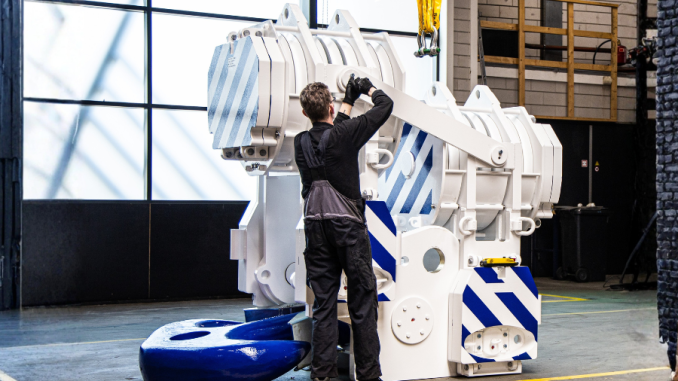
For decades, overhaul balls have been a familiar part of crane hoist systems across construction, lifting, and industrial jobsites. Their role has always been simple: keep tension on the wire rope when no load is attached and help the line feed smoothly off the drum. While effective for basic applications, these weighted balls were designed in an era when lifting technology was far less advanced. Today’s projects demand more control, greater efficiency, and improved safety. Rather than a wholesale shift from overhaul balls to hook blocks, contractors select the assembly that matches the lifting method. Multi-sheave hook blocks provide mechanical advantage and precision for reeved lifts, while overhaul balls remain appropriate for single-line work where line tension and a compact profile are key.
What An Overhaul Ball Was Designed For
Maintaining Line Tension During Operation
An overhaul ball, often called a headache ball, acts as a counterweight suspended beneath the crane’s hoist line. The weight keeps the rope taut so it does not unspool loosely from the drum. This tension helps prevent bird-nesting, reduces rope slack, and allows operators to lower the hook smoothly even without a load attached. Historically, this was critical on cranes that lacked advanced rope management or anti-two-block systems.
Limitations in Modern Lifting Environments
Despite their usefulness, overhaul balls only serve one purpose: weight. They do not assist with load distribution, provide mechanical advantage, or offer enhanced control. As lifting tasks became heavier and more complex, contractors found themselves needing multiple accessories or specialized rigging setups to compensate for what overhaul balls could not provide. This gap is one of the main reasons the industry began moving toward integrated hook block systems.
Why The Industry is Moving Toward Hook Blocks
Built-In Mechanical Advantage
Hook blocks incorporate multiple sheaves within a steel frame that allows the wire rope to be reeved several times. This reeving multiplies lifting capacity while reducing strain on the hoist drum. Instead of a single line carrying the load, force is shared across multiple rope passes. This design provides smoother lifting, increased efficiency, and improved handling of heavier loads.
Improved Stability and Rope Protection
Modern blocks also minimize rope twisting and uneven wear. By guiding the rope across engineered sheave grooves, hook blocks help maintain alignment and extend rope life. Contractors seeking better wire rope performance increasingly rely on specialized crane sheave systems.
Greater Control During Precision Lifts
Unlike overhaul balls, hook blocks allow operators to maintain better balance and positioning during lifts. Multi-sheave configurations provide controlled movement and reduced load sway. This is especially important in tight work zones or when handling long structural components where precision is critical.
Safety and Application-Based Selection
Reduced Risk from Suspended Dead Weight
Both overhaul balls and hook blocks can meet today’s jobsite expectations when used as intended. Where lift plans call for reeved configurations and enhanced control, a hook block is advantageous; where maintaining line tension with a compact, single-line setup is required, an overhaul ball remains common practice while utilizing the maximum line speed.
Compliance with Modern Jobsite Standards
Jobsite safety expectations continue to evolve, but compliance is application-dependent rather than product-type dependent. Contractors evaluate load case, lift plan, control requirements, and duty cycle to determine whether a single-line or reeved configuration is the correct solution.

Operational Benefits Contractors Notice Immediately
Less Wear on Hoist Systems
Because hook blocks create mechanical advantage, the hoist motor and drum experience lower stress per lift. This reduces maintenance cycles and extends equipment lifespan. Overhaul balls offer no such protection since they simply add constant weight to the line.
Faster Setup Across Multiple Lift Types
Hook blocks can adapt to a wide range of loads without switching accessories. Contractors no longer need to remove a ball and attach additional rigging for heavier lifts. The versatility saves time and keeps projects moving efficiently.
Better Performance In Wind And Dynamic Conditions
Wind and motion amplify instability when using traditional balls. Hook blocks stabilize the rope path and load, allowing safer lifting in challenging conditions often encountered on bridges, ports, and high-rise construction.
The Role Of Engineered Sheaves in Modern Blocks
Precision Machining Matters
The performance of a hook block depends heavily on the quality of its sheaves. Proper groove geometry reduces friction, limits rope deformation, and maintains load balance. Poorly designed sheaves accelerate wear and compromise lifting safety.
Why Contractors Prioritize High-Quality Components
Professionals increasingly choose engineered sheave and block assemblies because they directly influence lifting reliability and rope lifespan. Advanced manufacturing standards and tested materials are now considered essential in modern crane operations.
The decline of traditional overhaul balls is not about preference. It is about performance and safety. Hook blocks provide mechanical advantage, load distribution, improved stability, and compliance with modern lifting standards. They also reduce wear on cranes while increasing operational control across complex projects. As contractors continue modernizing their lifting fleets, the shift toward precision-engineered blocks and sheaves will only accelerate. For deeper technical insight into modern lifting components, contractors can review detailed resources on wire rope block technology.
What is the purpose of an overhaul (headache) ball on a crane?
An overhaul ball keeps tension on a single hoist line to prevent slack and ensure smooth rope payout when no load is attached.
Why are contractors switching from overhaul balls to hook blocks?
Hook blocks provide mechanical advantage, better load control, reduced rope wear, and improved safety for modern heavy and precision lifts.