














































Demolition in densely populated urban areas is a logistical challenge to say the least. Then add the extra considerations for taking down a well-reinforced jail, and you have a project that requires creative thinking and equipment up for the task.
Gramercy Group, a site development company, won a $125.5-million contract to demolish the former Manhattan Detention Complex and make way for a new building, which is part of New York City’s larger plan to close Rikers Island and replace it with a smaller, borough-based jail system. The contractor was selected, in part, due to their expertise in large-scale urban demolition, their safety record and their ability to integrate demolition and construction logistics in densely populated environments. But the project wasn’t going to be easy.
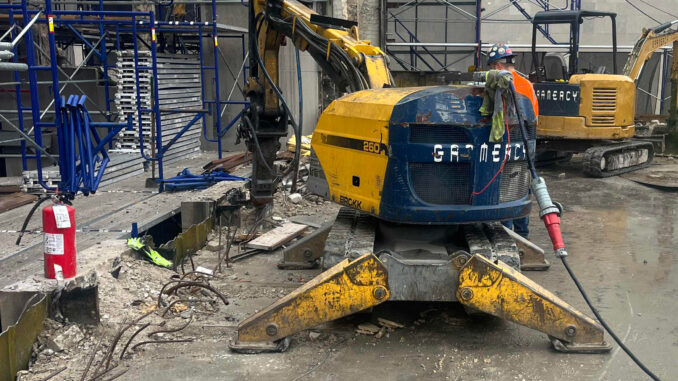
The complex rests in the middle of Chinatown on White Street in a thriving city center with occupied buildings on all sides. Gramercy required a fast, safe way to tear down the complex without the fear of material dropping into the street or creating disruptive noise levels. Gramercy relied on Brokk remote-controlled demolition robots to make the project faster, safer and more efficient. Here’s how they pulled it off.
The Demolition Begins
The two structures that make up the former Manhattan Detention Complex, the North and South Tower, both needed to be demolished to pave the way for the new detention center. The demolition and rebuild project aims to create a brand-new jail in the same footprint that will span 1.25 million square feet and rise approximately 15 stories high, making it the tallest jail in the world.
Gramercy first developed a comprehensive demolition plan and constructed a temporary swing space to support ongoing operations in the Civic Center district, which included multiple government buildings, ensuring continuity for the surrounding businesses.
“That’s the challenge in New York City,” said Gramercy superintendent Brian Wilhelm. “Normally, there’s a lot going on around you in the city. There are buildings right up next to you; you have the sidewalks and pedestrians … There’s a lot of moving parts.”
Not only did Gramercy need to protect the surrounding areas from damaging debris, but they also needed to minimize the noise and vibration. As such, the team had strict working hours between 7 a.m. and 6 p.m. throughout the three-year project and required efficient, quiet demolition equipment.
The North Tower
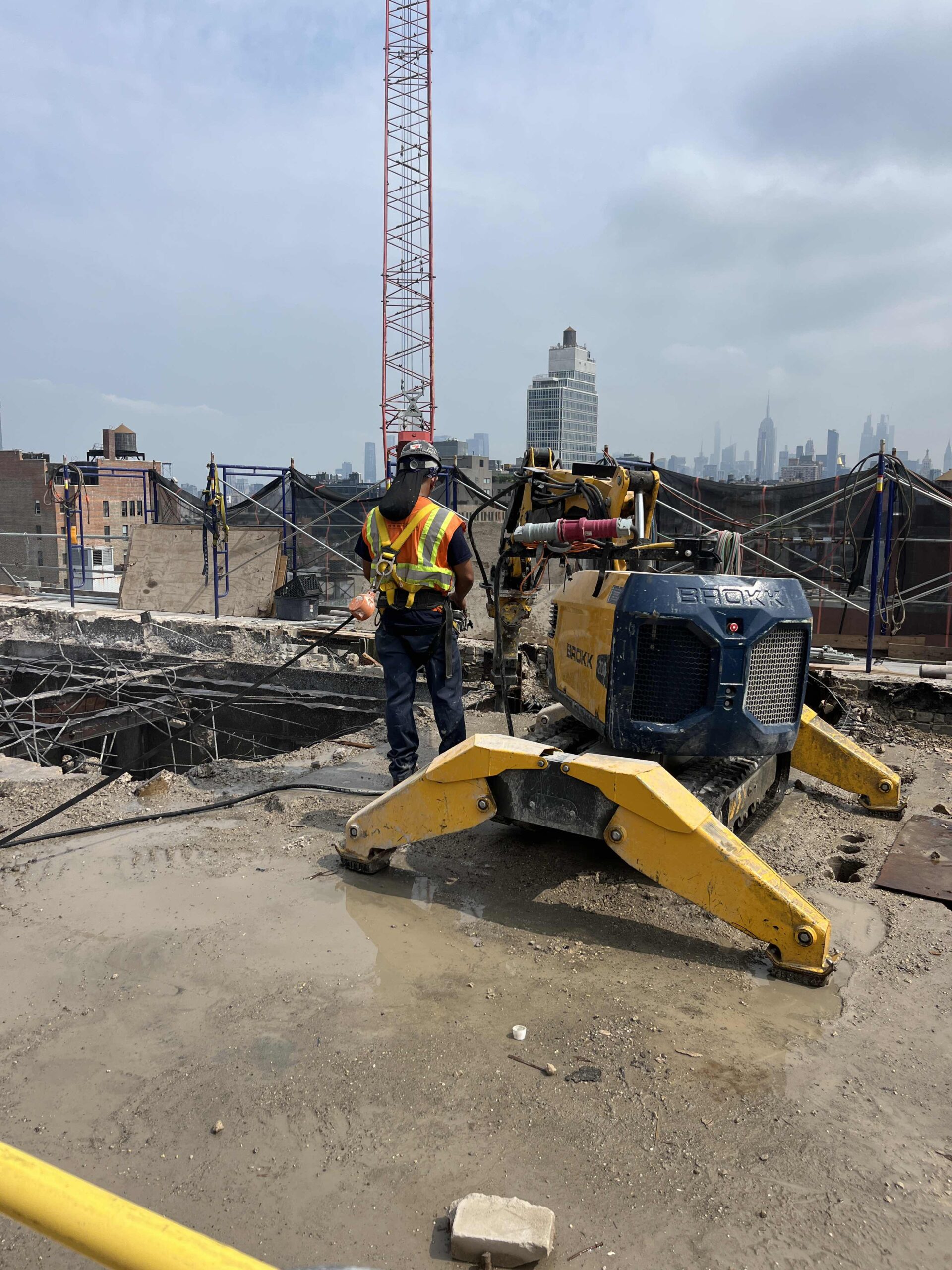
Gramercy started demolition on the North Tower first. However, the roof of the building featured a gymnasium with concrete beams that stretched 25 feet into the air. The team needed to be able to transport their equipment up to the roof of the building and work at height. Using a cabbed unit, such as a mini excavator, was out of the question for the safety of the operator. A larger excavator created the same safety issue along with size and weight challenges. They needed a small, lightweight, remote-controlled option they could move around easily. Having worked with Brokk for over a decade at this point, Gramercy knew the remote-controlled demolition robots were the way to go.
“Gramercy has integrated Brokk demolition robots into our operations for over a decade. These machines have become a staple in our toolkit for projects that require precision, remote access and enhanced safety,” Richard Peterson, vice president of Gramercy Group, explained. “These machines were selected because they support leading-edge demolition work while allowing operators to maintain a safe distance from active work zones. Their remote-controlled capabilities made them ideal for working on structurally sensitive areas where conventional equipment wasn’t practical.”
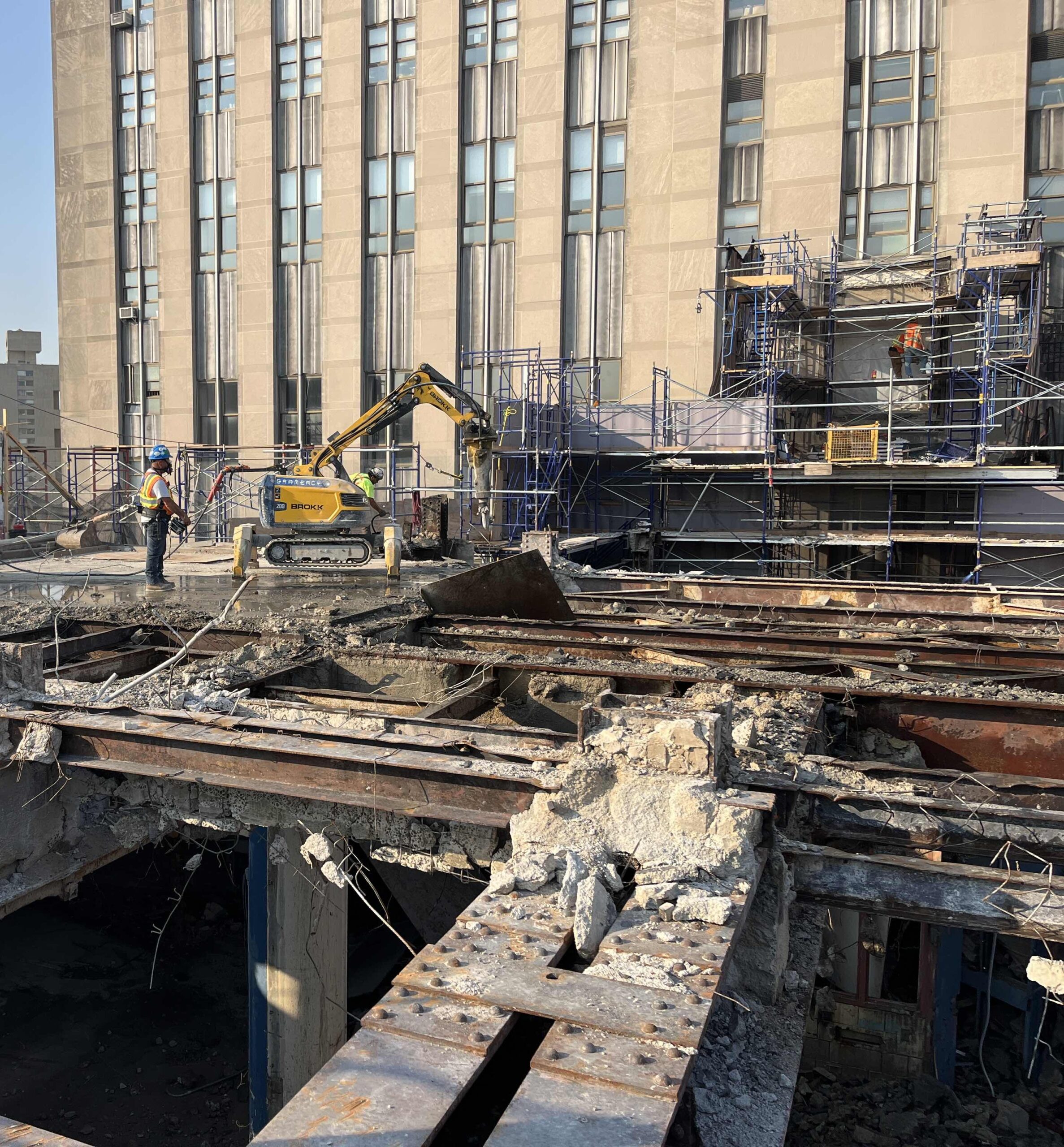
A Brokk 200, one of Brokk’s smaller electric models, only weighs 2.1 tons with a minimum width of 30.7 inches. To break down the concrete beams at the top of the North Tower, Gramercy used a 1300 Crawler Crane to lift the Brokk up to the roof in a basket. They secured the basket before using the breaker attachment to demolish the concrete beams. Because Brokk demolition robots are remote controlled, operators could be positioned at safe distances throughout the project.
“After doing all the engineering and seeing what the floors were rated for, I was 100% confident that Brokk was the way to go. This is the first time we’ve used a new Brokk 200,” Wilhelm said. “I just felt like, for the size, the Brokk 200 was a much stronger machine than the Brokks I’ve used before. They are just really great pieces of equipment.”
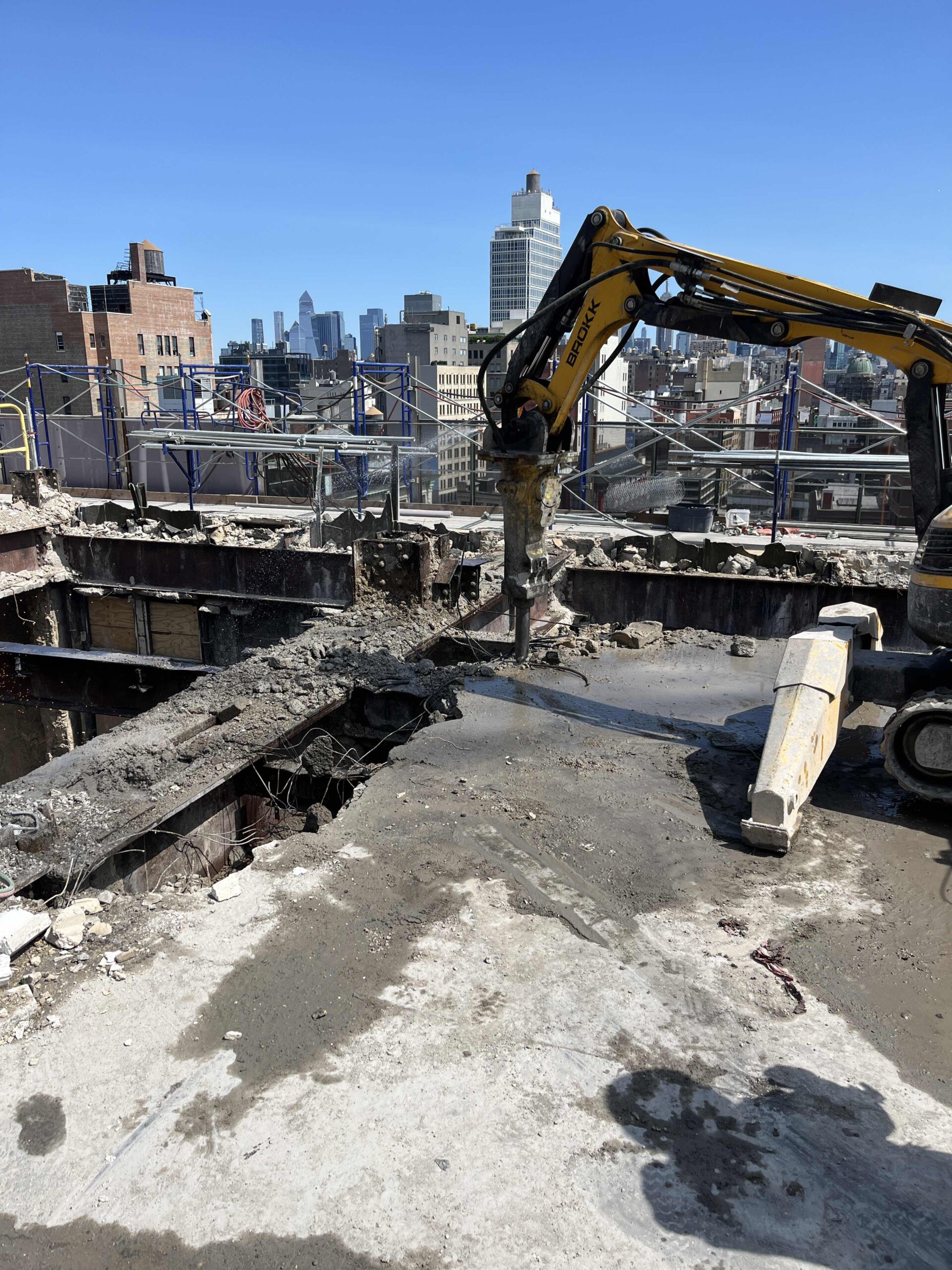
Once the concrete beams were broken down, Gramercy put two Brokk 200s to work breaking out the interior of each floor. The interior crew, working with breaker attachments and a couple small skid steers, went ahead of the working floor crew. In total, they had six Brokk operators with a full team of between 25-30 crew members, depending on the stage of the project. They tore out the jail cells and mezzanines, all reinforced with concrete and rebar, until they had a buffer of two or three floors between their work and the next crew. Then, three Brokk 200s with breaker attachments got to work wrecking the exterior, floor by floor. The cranes lowered the machines once the floor was demolished. Wilhelm said, “A lot of the operators are seasoned guys. I wouldn’t have put someone up on the working floor without a lot of experience. It’s an art, running a Brokk on top of a high rise.”
To remove material safely, the Gramercy team put a chute down the elevator shafts inside the existing building, which were built with 12- to 14-inch concrete walls. Debris was transferred to the ground crew to clean up and truck material off-site to be processed.
To dampen the noise during demolition, Gramercy set up scaffolding and sound proofing around the building. The scaffolding crew coordinated with the interior crew and the working floor crew to ensure the scaffolding cocoon helped dampen the noise of the demolition and keep dust and debris on the working floor. The Gramercy team also set up a water pump system, connected to the hydrant outside, to create an atomized water mist to capture dust in the air. Once the North Tower was completed, they moved on to the South Tower.
The South Tower
The majority of the demolition of the South Tower mirrored what was done with the North Tower. However, the asbestos made for an additional step on each floor. The Brokk operators required licenses to remove the asbestos containing non-friable mastic on the exterior of the building. The union operators hired for the job cordoned off an area and created a buffer zone between the demolition and the asbestos abatement demolition processes in place to protect themselves and others while completing demolition.
To protect the ground crew and surrounding area from asbestos, the Gramercy team brought containers up to the working floor with the crawler crane. As the Brokks demolished the exterior walls, the materials were packed into poly-lined boxes up on the working floor. The boxes would be wrapped, then the crane would take them down; and they would be trucked off to a processing facility.
Completion of Efficient Demolition Processes
The demolition of the North and South Towers finished up in early 2025. Overall, after preparation, planning and demolition, Gramercy worked on the project for just over three years. They found that the Brokks had minimal downtime and consistently maintained high performance throughout the project. Compared to manual or traditional methods, the Brokk units helped lower overall labor requirements and improve demolition speed and precision.
“This project exemplifies how modern demolition can benefit from the integration of robotic and remote-controlled technology. Brokk machines enabled us to meet ambitious safety, environmental and logistical goals while managing a high-profile, technically demanding site. Their role in the successful execution of the Manhattan Detention Center project highlights the future of demolition — where innovation, safety and efficiency work hand in hand,” Peterson said. Gramercy Group plans to continue working with Brokk for other demolition projects in the future.
Job Stats
Location: Manhattan, New York City, New York
Contractor: Gramercy Group
Dates:
North Tower: August 2023-March 2024
South Tower: April 2024-November 2024
Project Completion: 2025
Duration: 3 years
Equipment: 6 Brokk 200s with the 305 breaker attachments, 1300 Crawler Crane, Liebherr 1350 Hydraulic Crane CAT 303 mini excavators, CAT 390, 352, 349 and 320 excavators, material handlers, Gramercy-patented scaffolding and hand tools
